
Every electrician knows Kirchhoff's first law. The current that reaches a junction all leaves it, split between the wires according to how easily each one conducts.
Google has applied a close cousin of that arithmetic to links since 1998. SEOs described it with a kitchen image instead, juice poured from one page into the next.
The kitchen image stuck, and it carries a wrong idea with it. A jug that pours runs dry, while a page that links loses nothing.
Link juice is still the term most people meet first, in an audit or a link-building pitch. It deserves an explanation of what it gets right, what it gets wrong, and what it changes for the links you control.
What link juice means, and where the term comes from
Link juice is SEO slang for the importance a page passes to the pages it links to. The term is a folk name for PageRank, the link-scoring system Google was built on in 1998.
Sergey Brin and Larry Page started from a simple picture. Someone clicks links at random, page after page, and now and then jumps somewhere new.
The pages this wanderer lands on most often are the important ones. The original Google paper by Brin and Page called that probability PageRank.
A page earns its PageRank from the pages that link to it, and passes some on through its own links. SEOs pictured that flow as a liquid, and the name followed.
Link juice and link equity are the same thing
| Term | Who uses it | What it refers to |
|---|---|---|
| Link juice | SEO practitioners, informally | The value a link passes, pictured as liquid |
| Link equity | Agencies, tools, client reports | The same value, in a formal register |
| PageRank | Google and researchers | The algorithm itself and the score it computes |
The two SEO terms are interchangeable. Backlinks bring link value into a site from outside, while internal links decide which of your pages it reaches.
Why SEOs distrust the concept, and why it still helps
Nobody outside Google can measure link juice, because the real formula has changed and is not public. What every known version shares is a direction, and that direction is enough to decide where links should go.
PageRank has not disappeared. Google's guide to its ranking systems still counts it among its core systems, while noting that the way it works has evolved a lot since launch.
It is also one signal among many. In 2017, Gary Illyes of Google confirmed it was still used alongside hundreds of other signals, about a year after Google retired the toolbar that displayed it.
So any "link juice" figure a tool shows you is that tool's own estimate. It may be a sensible one, but it is not a reading of Google's number.
The direction, however, has never changed. Every version Google has published keeps the same skeleton, and that skeleton gives you rules you can rely on without measuring anything.
- A page linked from your strongest pages receives more than one linked from a forgotten archive.
- A page nobody links to receives nothing at all.
- A link on a page carrying 200 links passes less than the same link on a page carrying 10.
This is why link juice is best used as a compass for deciding where links go, never as a gauge to read.
How link value actually moves between pages
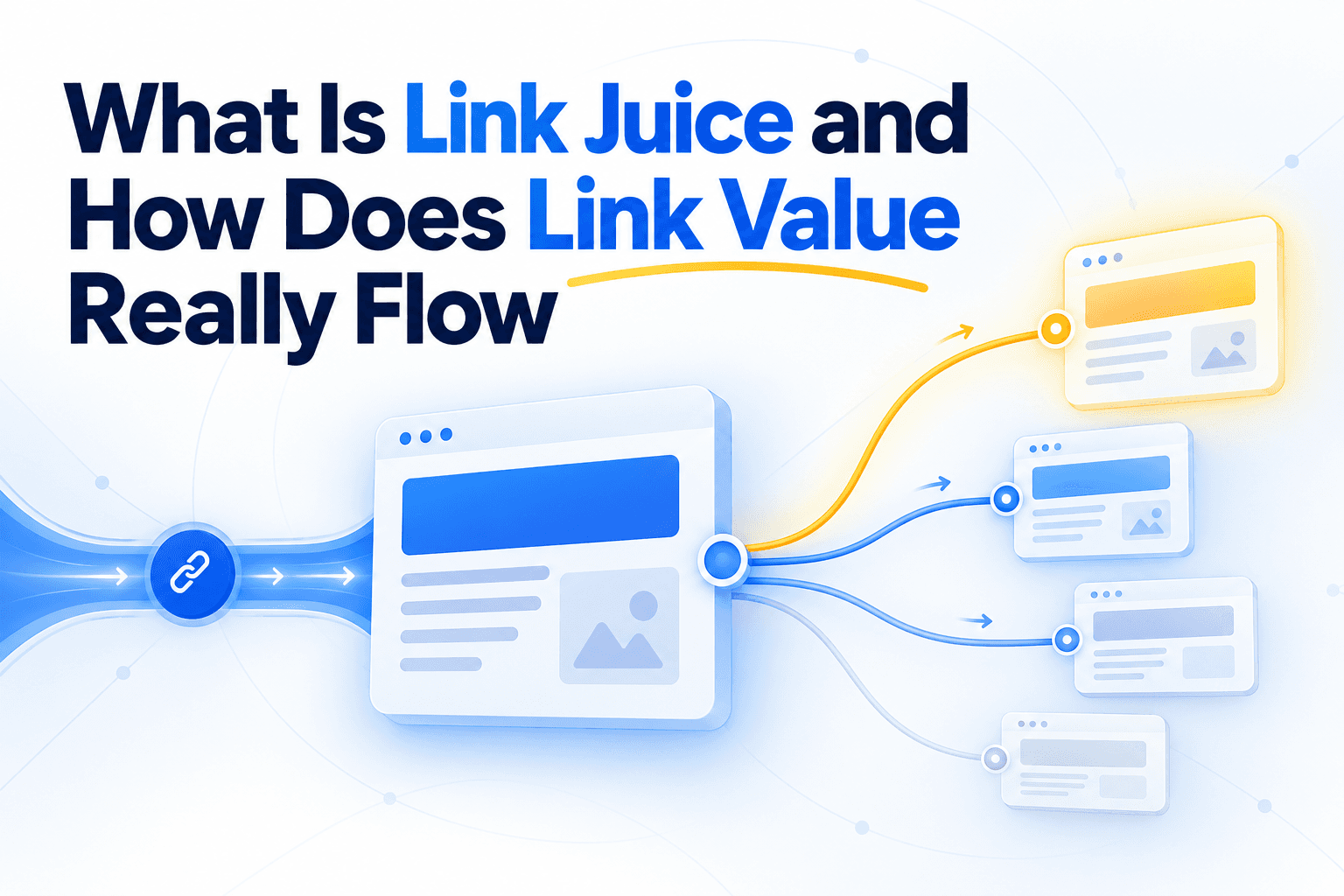
A page's value is shared between the links it contains, the way current divides at a junction. Adding links shrinks each share, but the page that links loses nothing, because its own value comes from the links it receives.
A link never drains the page that places it
In the PageRank formula, what a page passes on is divided between its links. Matt Cutts, then head of webspam at Google, confirmed this division in 2013 in a video on how many links a page should carry.
Take a page worth 10 points, in the simplified form Cutts himself used.
| Links on the page | Share per link | Page's own value | |
|---|---|---|---|
| Before | 5 | 2 points | 10 points |
| After adding 5 links | 10 | 1 point | 10 points |
Each share halves. That is the part everyone remembers.
The page keeps its 10 points either way. Its score is computed from the links pointing to it, so the links it gives never enter its own calculation.
This is why, in the published formula, linking out costs a page nothing. Cutts said as much in 2009, when he advised bloggers not to close their comments to hoard PageRank.
Current is a better picture than juice
Juice suggests a jug that empties as it pours. Believing that, SEOs spent years rationing links and trying to "save" value with nofollow.
Current at a junction behaves differently. Two of its properties match what the formula does.
- It divides. Every outgoing wire takes a share of what arrives, and more wires mean smaller shares.
- Nothing is used up. Whatever reaches the junction leaves it, however many wires it feeds.
The parallel goes deeper than a figure of speech. PageRank describes a random walk across links, and mathematicians Peter Doyle and Laurie Snell showed that random walks and electric networks obey the same laws.
Their result is exact only for networks where every connection runs both ways, which the web is not. As a picture of how value divides, current still beats juice.
What this changes for internal linking
Internal links move value between your own pages without destroying it, except when they carry nofollow. Each new link on a page thins the share of the others, so the real question is which pages deserve a share.
An internal link moves value without destroying it
When one of your pages links to another, what it passes on stays on your site. Adding an internal link changes who receives value, not how much is passed.
The exception is nofollow. In the same 2009 post, Cutts explained that a nofollowed link still takes its share, and that this share evaporates instead of going to the other links.
Internal nofollow is the one documented way to lose value inside your own site. Google has not detailed how it handles that share today, which leaves no reason to risk it.
Each new link cuts a thinner slice
The old rule of 100 links per page was never about value. In his 2013 video, Cutts traced it to a technical limit on how much of a page Googlebot indexed at the time.
Google has since dropped the rule. It now asks only for a "reasonable" number of links, and keeps the right to act on pages that look spammy with links.
The machine limit is gone, and the division is not. Every link you add to a page makes every other link on it a little thinner.
So the useful question is not how many links a page can afford. It is which pages deserve a share, and which links only dilute it.
Seeing where value currently goes is the hard part once a site passes a few hundred pages. Unveil SEO maps every page and every existing link, so the pages that receive no share at all stand out.
On sites with thousands of URLs, internal links also shape where Google spends its crawl budget.
How to put link value where it counts
Remove nofollow from internal links, give buried pages a path from pages that already receive value, and put each link inside a sentence that explains where it leads. The goal is better-placed links, not more of them.
- 1
Remove nofollow from internal links
A nofollowed internal link wastes the share it takes. If a page should not receive value, the better question is whether it needs that link at all.
- 2
Give buried pages a path from strong ones
Pages that already receive links pass value on, and orphan pages receive none. An analysis of 23 million internal links across 1,800 websites found a correlation with Google clicks, though not proof of cause.
- URLs with 0 to 4 internal links averaged about 2 clicks from Google Search.
- URLs with 40 to 44 internal links averaged about four times as many.
An internal link audit surfaces the pages with no path in.
- 3
Put each link inside the sentence that explains it
Keep the links a reader would actually want to follow, and let the words around each one say where it leads.
- Bolted. "Value is split between links. Read more here."
- Woven. "Each new link cuts a thinner share of the page's value."
The second anchor describes its destination, which is most of what makes an internal link work.