
The study at a glance. We collected the contextual internal links of 7,472 articles on HubSpot’s blog and matched them with 188,020 Google US rankings, from July to October 2026, with the method of our study of six software vendor blogs.
Our finding fits in one sentence. On HubSpot, what makes the difference at the top of Google is the quality of each link, and no longer the fact of being linked.
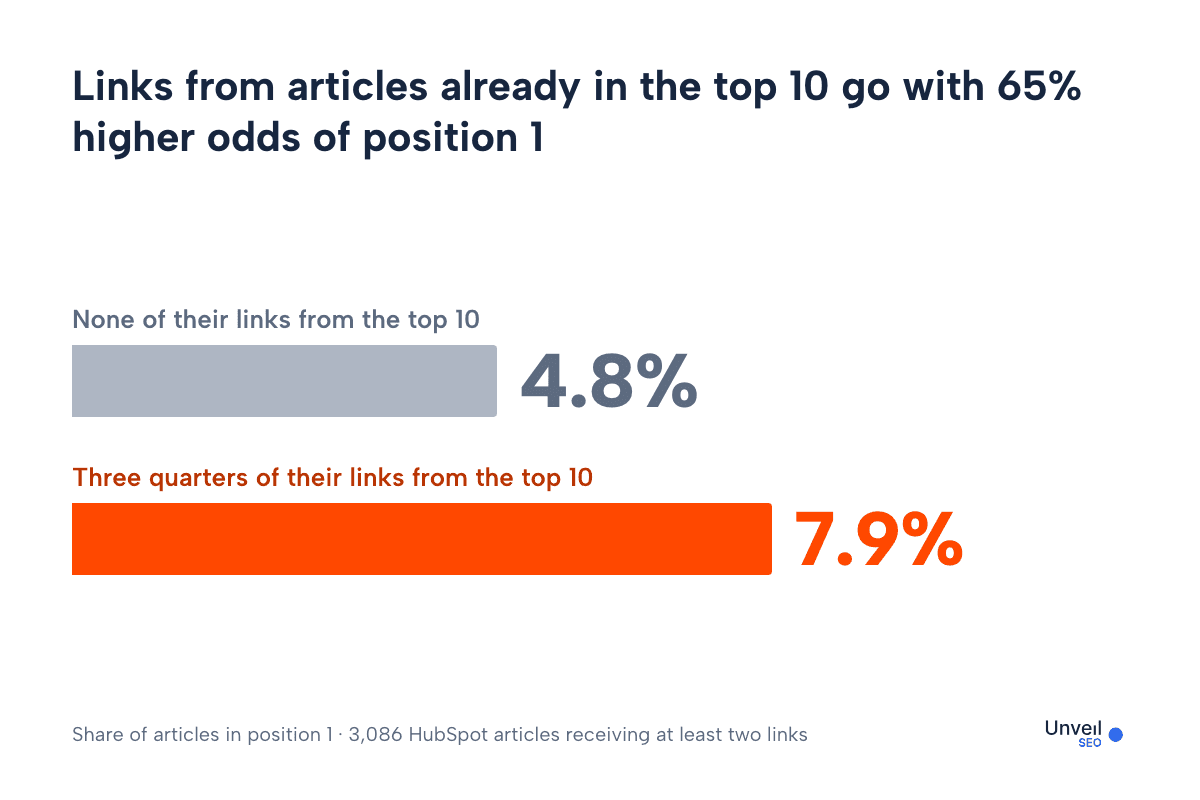
- Articles that receive their links from articles already in the top 10 are 65% more likely to rank in position 1, and 28% more likely to reach the top 10.
- A page is 44% more likely to rank in the top 10 for a query when a link pointing to it uses words from that query as its anchor.
- Articles whose anchors use the words of the H1 of the pages they link to are 22% more likely to rank in the top 10.
- For these three levers, the gap is larger for the top 3 than for the top 10.
- Simply being linked goes with appearing in Google, not with ranking at the top, unlike on the vendor blogs.
All percentages are relative gaps. “65% more” means going from 4.8% to 7.9% of articles in position 1, and each figure comes with its starting point below.
They compare articles of comparable length, age, backlinks and blog section. They show an association, not yet proof of an effect.
For a content team, the first move is to link the articles left behind from articles already in the top 10, with an anchor taken from a query the target page aims for.
In our study of six software vendor blogs, being linked made a clear difference.
An article that received and gave at least one link in its text reached Google’s top 10 47% of the time, versus 33% for an isolated article.
Two questions remained open. Those blogs were too small to say whether the anchor of a link matters, or whether adding links beyond the first changes anything.
HubSpot’s blog was the place to ask them. It has 7,472 articles, backlinks on nearly all of them, and the team behind it popularized topic clusters.
At Unveil SEO, our platform builds contextual internal linking from the text a site has already published. We applied exactly the same method to HubSpot’s blog as to the vendor blogs.
What counts as a contextual link. It is a link placed in the text of another article, in a sentence, a list or a table. Menus, listing pages, buttons, images and reading suggestion blocks don’t count.
The answer fits in one sentence. On HubSpot, what makes the difference at the top of Google is the quality of each link, and no longer the fact of being linked.
We measured that quality through three levers, the page a link comes from, its anchor, and the anchors an article gives. The first one stands out most, at the very top of the results.
Links from articles already in the top 10 go with 65% higher odds of position 1
The first lever is the source of a link, the article it comes from.
For each article, we counted how many of the links it receives come from articles already ranking in the top 10 for at least one keyword.
We kept the 3,086 articles that receive at least two links and compared two groups, those with no link from a top 10 article and those with three quarters of their links from one.
- In the top 10. 36% of articles without top 10 sources, 46% of the others, 28% more.
- In the top 3. 12% versus 17%, 41% more.
- In position 1. 4.8% versus 7.9%, 65% more.
The higher the position, the larger the gap. This is also the only one of the three levers whose gap we can measure all the way to position 1.
Only 298 articles hold position 1, so this figure has a wider margin of error. It remains statistically significant.
The comparison is made at an equally strong topic, which we explain just below. A link from a page that already ranks well goes with much better positions than a link from a page that doesn’t.
When three quarters of an article’s links come from top 10 articles, its odds of position 1 go from 4.8% to 7.9%, and of the top 10 from 36% to 46%.
Couldn’t the topic simply be doing the work?
The objection is fair. Articles in the top 10 often cover topics that do well, and the articles they link to may share that luck.
To test it, we gave each article a topic score, the share of its 10 most similar articles that rank in the top 10. A high score means the topic tends to do well on HubSpot.
Comparing articles with the same topic score shrinks the gap only a little.
- Without the topic score, the gaps are 35% for the top 10, 43% for the top 3 and 76% for position 1.
- With it, they are 28%, 41% and 65%, the figures above.
The advantage of a link from a well-ranked page isn’t explained by its topic doing well on its own.
The source is where a link starts. Its other end, the anchor, says where it goes.
An anchor drawn from a query counts almost as much as that query in the H1
The second lever is the anchor, the clickable text of a link. We wanted to know whether its words change the queries on which the page it points to ranks.
We say an anchor is drawn from a query when all its words appear in that query. It needs at least two meaningful words, since words like “the” or “of” don’t count.
- The page. “What is NPS”, on HubSpot’s blog.
- Its anchors. 34 links from other articles say “Net Promoter Score”, and 3 say “NPS surveys”.
- The match. “NPS surveys” is drawn from the query “nps survey”, but not from “nps scale”.
The example illustrates the measure, not a result.
The anchor “NPS surveys” counts as drawn from the query “nps survey”, not from “nps scale”.
We then compared each page with itself, query by query, across 5,820 articles. A page ranks better on the queries its anchors are drawn from than on its other queries.
- In the top 10. On 10.4% of those queries, versus 7.2% of its other queries, 44% more.
- In the top 3. On 1.9% versus 1.1%, 65% more.
For comparison, having the query in the page’s H1 or title goes with 3.8 more points of top 10, and an anchor drawn from it with 3.2. The anchor weighs almost as much as the H1.
A page ranks in the top 10 for 10.4% of the queries its anchors are drawn from, versus 7.2% for the others.
Isn’t that just pages optimized for those queries?
That is the first objection. An analysis of 23 million internal links across 1,800 sites found far more traffic on pages receiving at least one exact-match anchor, and its author noted they may simply be better optimized.
Our comparison avoids that trap. Each page is compared with itself, so its quality, its backlinks and its age stay the same from one query to the next.
We also accounted for whether the query appears in the H1 or title, and for its search volume and difficulty.
Doesn’t an anchor close to the keyword look like over-optimization?
We often hear that an internal anchor too close to the keyword is risky. On HubSpot, nothing supports that fear.
What matters is that the anchor’s words come from the query, not that the anchor contains the whole query. Anchors containing the full query go with a much smaller gap.
So the useful anchor is a short phrase taken from the query, like “NPS surveys”, rather than the exact keyword wedged into a sentence. Google’s guidelines on links point the same way, asking for descriptive, concise anchors.
A possible reading of anchor variety. The same analysis of 23 million links found more clicks on pages receiving more varied anchors. If each anchor taken from a different query goes with better rankings on that query, varied anchors would simply cover more queries.
So far, the links an article receives. The links it gives say something about it too.
Articles that link to their neighbours with precise anchors rank higher more often
The third lever concerns the links an article gives, not the ones it receives. It goes against a common intuition, which we come back to below.
What a precise anchor is. An anchor is precise when its words appear in the H1 of the page it points to. For each article, we averaged the precision of all the anchors it places.
“What is a blog”, on HubSpot’s blog, gives both kinds.
- A precise anchor. “best blogging platforms” points to “The 11 best blogging platforms”, whose H1 contains all its words.
- An imprecise anchor. “high-quality, consistent content” points to “12 Benefits of Content Marketing”, which shares only “content” with it.
The example illustrates the measure, not this article’s rankings.
“best blogging platforms” is a precise anchor, since all its words appear in the H1 of the page it points to.
Among the 5,355 articles that give links, we compared those at the low end of precision, where about one anchor word in five appears in the target’s H1, with those at the high end, where all of them do.
- In the top 10. 32% at the low end, 39% at the high end, 22% more.
- In the top 3. 10% versus 14%, 36% more.
The gap holds even when we control more closely for the article’s age and its last update, so it isn’t a matter of when the article was written.
Articles giving the most precise anchors rank in the top 10 39% of the time, versus 32% for the least precise.
Doesn’t linking out spread a page’s authority?
It is one of the most widespread ideas in SEO. Each link an article gives would take away part of its authority, so links out should be rationed.
The idea traces back to the PageRank formula Sergey Brin and Larry Page published in 1998. In it, a page’s score comes from the pages linking to it, and each splits its own score among the links it gives.
A link out therefore reduces what each destination receives, not the score of the page that gives it. Google has changed a lot since 1998, so this proves nothing about today, but the original formula never penalized the linking page.
The advice we would drop. We see this as the most misguided idea in internal linking. A team should limit the links an article gives by relevance, not by fear of losing authority.
Our data point the same way, without testing dilution directly. On HubSpot, articles giving precise anchors are more often at the top, and on the vendor blogs, giving a contextual link already went with 8 more points of top 10.
Our data don’t say why precise anchors go with better rankings for the article that places them.
Three levers, then. Do they weigh the same at every level of the ranking?
The higher you aim in Google, the larger the gap tied to link quality
The three levers share one pattern. Their gap is larger for the top 3 than for the top 10.
| Lever | Top 10 | Top 3 |
|---|---|---|
| Links from articles in the top 10 | +28% | +41% |
| Anchor drawn from the query | +44% | +65% |
| Precise anchors given | +22% | +36% |
Each figure is the extra chance of ranking that goes with the lever. For example, a page has 44% more chances of the top 10 on a query its anchors are drawn from.
In other words, the higher you aim in Google, the more link quality goes with a difference. Few pages reach the top 3, so we express each gap against its starting point rather than in points.
At position 1, only the source lever shows a gap we can demonstrate, the 65% seen above.
For all three levers, the relative gap is larger for the top 3 than for the top 10.
Do editors simply link what already works?
It is the objection any careful reader raises, and it surely happens to some extent. Editors may link first to and from the articles that already rank, and we collected the links in October, after the rankings were measured.
Several results make it unlikely to be the whole story.
- The source result holds when topics are equally strong.
- The anchor result compares a page with itself.
- The result on anchors given holds after a closer control of age.
Our data still can’t rule it out. That is why we plan an experiment on a client site.
Which brings us back to the question we started from, whether simply being linked still counts.
On HubSpot, being linked goes with appearing in Google, not with ranking at the top
Start with how much HubSpot links its articles. It isn’t better linked than the vendor blogs.
- 51.5% of HubSpot articles aren’t linked both ways, versus 47.3% on the vendor blogs.
- 15.6% are isolated, receiving and giving no contextual link, versus 16.5%.
- An article has 3.5 contextual links with other articles on average, versus 3.2.
Even a blog of HubSpot’s size leaves one article in six without any contextual link, received or given.
51.5% of HubSpot articles aren’t linked both ways, versus 47.3% on the six software vendor blogs.
Yet the gap that stood out on the vendor blogs is gone. Take 100 isolated HubSpot articles and 100 articles linked both ways, of comparable length, age, backlinks and section.
- In the top 10. 30 isolated articles versus 33 linked ones, a gap that isn’t significant. On the vendor blogs, it was 33 versus 47.
- In the top 100. Being linked still goes with 6.9 more points, a gap that holds in every variant we tested.
On HubSpot, being linked goes with better odds of appearing in Google, not of ranking at the top.
Isolated versus linked both ways, 30% versus 33% in the top 10 on HubSpot, and 33% versus 47% on the vendor blogs.
Placing more links in an article goes with nothing more
The first study left open how many links count beyond the first. On HubSpot, placing more of them in an article goes with nothing more.
We sorted the articles by how many links they give, into four equal groups, typically with 1, 3, 5 and 7 links.
- Articles giving no link. 31% in the top 10.
- Articles giving 1, 3, 5 or 7 links. 33 to 34%, whatever the number.
This doesn’t contradict the analysis of 23 million internal links, where pages receiving more links, menus included, got more clicks up to about 45. It measured links received and clicks, while we measure links placed in the text and rankings.
So why do the two studies tell different stories?
The difference with the vendor blogs likely comes from the whole site
HubSpot and the six vendor blogs differ on almost everything that makes a site strong. Domain rank, query difficulty and backlinks come from DataForSEO.
| HubSpot | Six vendor blogs | |
|---|---|---|
| Articles | 7,461 | 301 per blog on average |
| Median age | 6.1 years | 2.3 years |
| Articles without backlinks | 0.3% | 76.5% |
| Domain rank, out of 1,000 | 681 | 214 to 343 |
| Median query difficulty, out of 100 | 13 | 0 |
Backlinks do matter on HubSpot. An isolated article with 100 referring domains has 42% odds of ranking in the top 10, versus 17% with a single one.
We then looked at the HubSpot articles that most resemble the vendor ones, with few backlinks, recently published or on easy queries. Even there, being linked doesn’t go with more top 10 rankings.
Our hypothesis is that the difference comes from the whole site, with the domain’s authority first. One site can’t confirm it, so we will check it on several.
Our view. We read this as a reason to work on internal linking more as a site grows, not less. Authority lets a site compete on harder queries, where the top 3 decides, and that is where link quality goes with the largest gaps.
It is also a lever few sites use fully, HubSpot included.
Judge each internal link by its anchor and its source
The work starts from a list of the blog’s articles, with their rankings and the contextual links they receive and give.
- 1
Find the articles already in the top 10
In Google Search Console, list the articles that rank in the top 10 for at least one query. They are the best places to link from.
- 2
Pick the articles they could link to
Look for articles on a neighbouring topic that rank lower or receive no contextual link. Place the link where that topic comes up naturally in the text.
- 3
Write the anchor with the words the destination targets
Use two or more words of a query the destination page aims for, ideally words of its H1, like “NPS surveys” for “nps survey”. The whole query doesn’t need to fit.
- 4
Track the change
Note the date, then track the rankings of the linked pages on their target queries. Leaving a few comparable articles untouched helps separate the effect from the blog’s overall trend.
For a few dozen articles, a spreadsheet will do. Beyond that, Unveil SEO finds incoming and outgoing links in the text of existing articles, with anchors of two to five words, and surfaces isolated articles.
The questions we want to settle
This study answers some of the questions the first one left open, on the anchor, the number of links and the top 3. It opens others, grouped by how we plan to answer them.
- An experiment on a client site, to show whether articles that gain well-chosen links go on to rank better, and so which way the relationship runs.
- Other large sites, to check whether the difference with the vendor blogs comes from domain authority, and whether these levers hold beyond HubSpot, in other languages and sectors.
- The mechanism behind anchors given, since our data show that articles placing precise anchors rank higher more often, without saying why.
- AI answers, to find out whether anchor and source quality also go with citations in AI search, which we haven’t measured here.
We will update this article at each step.
Method and data
We collected the internal links of 7,472 articles on HubSpot’s blog with the Unveil SEO crawler, then matched them with their Google US rankings from July to October 2026, using DataForSEO data. Only significant gaps are presented as findings.
The site and the articles
The study covers the English articles of blog.hubspot.com, leaving out the homepage, listing pages and topic pages. Comparisons that account for age set aside 11 undated articles, hence 7,461 articles in the comparison with the vendor blogs.
The sources
| Data | Source |
|---|---|
| Internal links | Unveil SEO crawler, October 22, 2026 |
| Google US rankings | DataForSEO Labs, July to October 2026 |
| Backlinks | DataForSEO Backlinks, referring domains, raw count |
| Article age | First capture in the Wayback Machine |
| Topic proximity | Titles, H1s, meta descriptions and URLs |
HubSpot regularly republishes its articles, and the dates it shows mark the latest update. Age therefore comes from the first Wayback Machine capture.
How links were classified
A link counts as contextual when it sits in the text of another article in the study, under the first study’s rules. Suggestion blocks, buttons, images and links from listing pages are set aside, leaving 26,228 pairs of linked articles.
How articles were compared
- At the article level, each result comes from a logistic regression at comparable length, age, referring domains and section, with 95% ranges from resampling within each section.
- At the query level, each page is compared with itself across 180,039 pairs of a page and a query, accounting for the query in the H1 or title, its volume and its difficulty.
- For sources, the strength of a topic is the share of an article’s 10 closest articles by topic that rank in the top 10, leaving out those that link to it.
Robustness
- The top 100 gap tied to being linked is significant in all 8 variants tested.
- The result on anchors given holds with age in years and a squared term, and with HubSpot’s republication date.
- As a control, a page doesn’t rank better on a query that appears in an anchor it gives to another article (3.3 points lower in the top 10). The anchor result concerns anchors received.
- Backlinks are counted raw, spam included. On a sample of 200 articles, 12% of referring domains looked like spam, without a gap between groups large enough to justify a filter.
Limitations
- The study shows an association, not proof of an effect, and the links were collected after the rankings.
- It covers a single site, in English, on Google US.
- Rankings are estimated by DataForSEO, which ignores queries with fewer than about ten searches a month and keeps one HubSpot page per query.
- Position 1 rests on few cases, 298 articles and 620 queries.
- Article age is measured roughly, from the first Wayback Machine capture.
- 595 links to old URLs that redirect aren’t counted (1.9% of links), and since article text wasn’t exported, the query’s presence in subheadings isn’t controlled.
Cite this study
Unveil SEO, Internal link quality and Google rankings, a study of 7,472 articles from HubSpot’s blog, November 2026, https://unveilseo.com/blog/hubspot-internal-linking-study. The charts may be reused freely, with a link to this page.