
Your homepage has 200 backlinks from strong domains. Your product pages have 3 internal links each.
The authority enters your site and stays on the homepage. The pages that need to rank never see it.
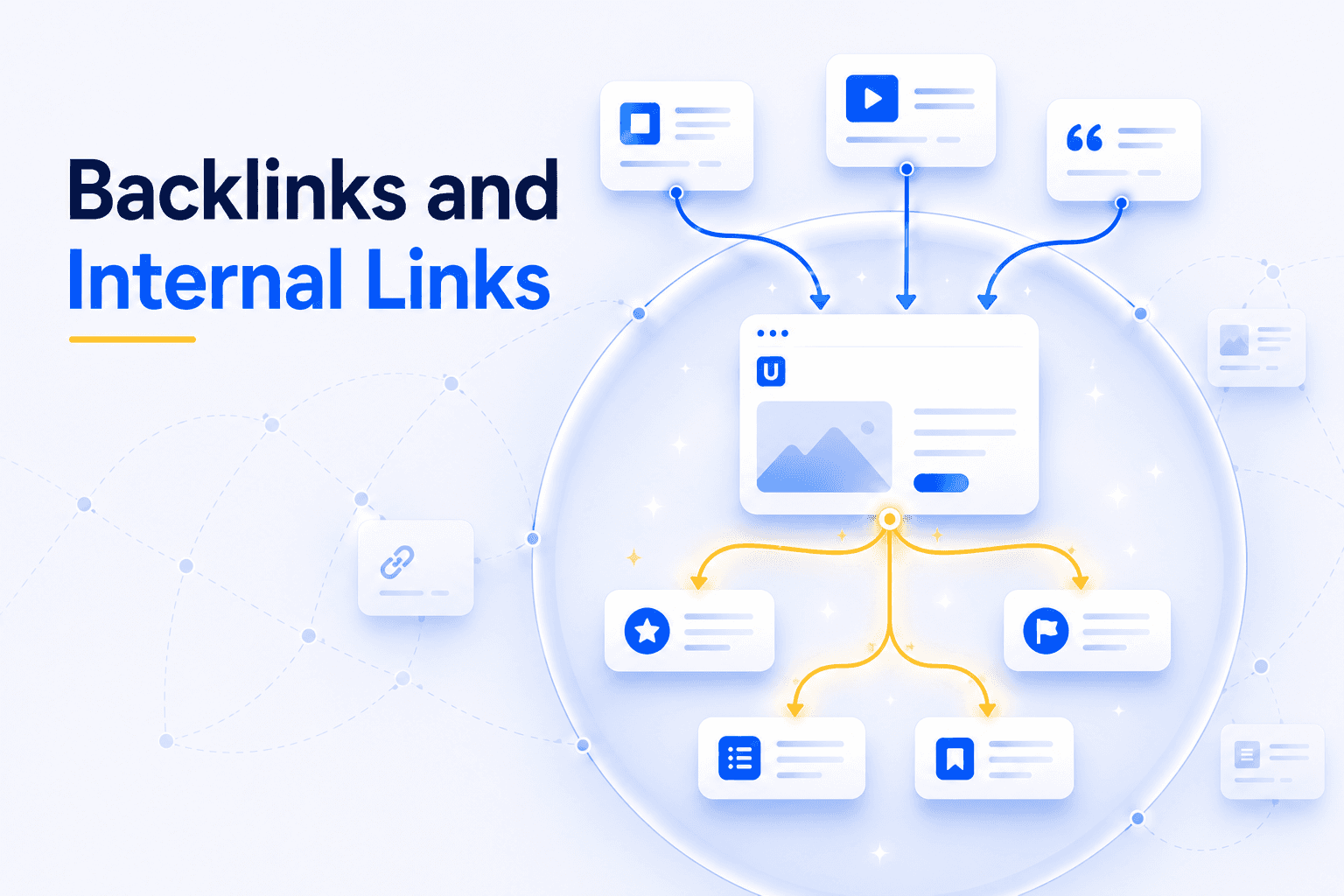
This is the most common waste in SEO: treating backlinks and internal links as separate tactics when they are two halves of one system. Backlinks bring authority in. Internal links decide where it goes.
What each one actually does
Backlinks bring authority into your domain from the outside. Internal links distribute that authority to the pages that need it. Neither creates value alone.
Think of it like a power grid. Backlinks are the high-voltage line from the power plant to your building. Without it, there is no electricity.
Internal links are the wiring inside the building that delivers power to each room.
A building connected to the grid but with no internal wiring has electricity at the meter and darkness in every room. A building with perfect wiring but no connection to the grid has nothing to distribute.
| Dimension | Backlinks | Internal links |
|---|---|---|
| Origin | External sites link to you | You link between your own pages |
| What it signals | "This site is trustworthy" | "This page matters for this topic" |
| Who controls it | Other sites (you can influence, not control) | You (editorial and structural decisions) |
| What it costs | Outreach, content marketing, PR, time | Editorial effort, structural planning |
Both carry signal. But they do different jobs.
Backlinks tell Google your site deserves authority. Internal links tell Google which pages deserve it most.
How authority flows from one to the other
Backlink authority does not spread evenly across your site. It flows through your internal links, losing a fraction at each step. If your linking structure does not redistribute it, authority pools on a few pages and the rest get nothing.
The mechanism is PageRank's damping factor, set at 0.85 in the original Google algorithm.
Think of it like a bucket of water passed from person to person in a chain. Each person spills about 15% before passing it on.
After 3 people, roughly 61% of the water remains. After 5: about 44%.
Applied to your site:
- ✓ Product page 2 hops from a backlinked homepage → receives ~72% of the signal
- ✓ Product page 3 hops away → receives ~61%
- ❌ Product page 5 hops deep → receives ~44%
- ❌ Product page with zero internal links from any backlinked page → receives nothing
This is an approximation (real PageRank is iterative and involves the entire link graph), but the principle holds: every hop costs signal, and pages with no path from backlinked pages are invisible to authority flow.
What "authority pooling" looks like in practice:
- ✓ Redistributed site: Homepage earns backlinks → links to category pages → categories link to products. Authority reaches every level. Deep pages rank.
- ❌ Pooled site: Homepage earns backlinks → links only to "About" and "Contact." Product pages have 2 internal links from a sidebar. Authority stays at the top. Deep pages don't rank despite strong domain metrics.
Why the balance is shifting toward internal links
Google is openly reducing the weight of backlinks as a ranking factor. The signals replacing them (topical understanding, crawl demand, user engagement) are all driven by internal linking.
Google's John Mueller predicted at Brighton SEO that backlinks' importance will continue to drop over time. Duy Nguyen from Google's Search Quality team confirmed that backlinks carry less significance today than when Google first started.
What is gaining weight instead:
- Topical signals from anchor text. Internal link anchors tell Google what a page is about. This is a signal you fully control.
- Crawl demand from link popularity. Pages with more internal links get crawled more often.
- Engagement signals (NavBoost). Users clicking internal links on a page feeds Google's behavioral ranking system, as covered in measuring internal link effectiveness.
This does not mean backlinks are dead. A site with zero backlinks has no external authority to distribute, no matter how perfect its internal linking.
But the ROI equation is shifting. One case study showed a site moving from average position 14.7 to 8.9 in a single week from internal link optimization alone, with no new backlinks.
That kind of result from pure redistribution was harder to achieve five years ago.
How to connect the two in practice
The highest-ROI linking action is connecting existing backlink authority to pages that need it. Three steps.
Step 1. Find your authority entry points.
In Google Search Console (Links report) or Ahrefs, identify your most backlinked pages. These are the pages where external authority enters your site.
Step 2. Check whether they redistribute.
Open your Link Graph in Unveil SEO and look at those backlinked pages. Do they have outbound internal links to your priority pages? Or are they dead ends that accumulate authority without passing it on?
A page with 50 backlinks and zero contextual outbound links is a bottleneck. The authority comes in and stops.
Step 3. Add contextual links from backlinked pages to underlinked targets.
Use Unveil SEO's Outbound suggestions to find where each backlinked page should link. The tool recommends semantically relevant targets based on content analysis.
The priority targets: pages with high impressions but position 8-15 in GSC. These are pages on the edge of page one. A few internal links from authority pages can push them over, as identified in your internal link audit.