
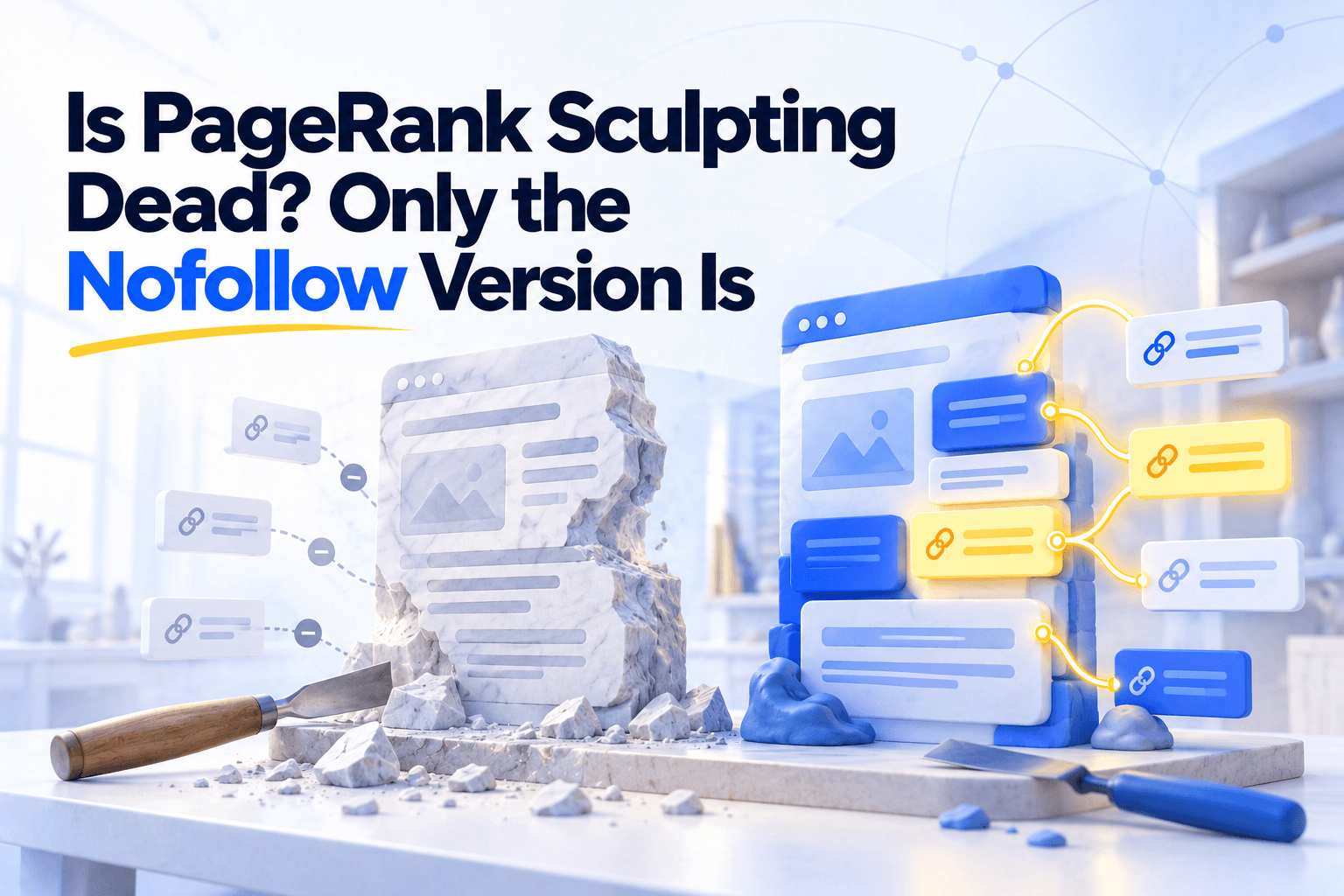
Sculptors have always shaped figures in two ways. Michelangelo carved marble away until the figure appeared, and Rodin built his up in clay.
PageRank sculpting took its name from the first method. For years, SEOs tried to steer authority through their sites by cutting links, and that is the method Google shut down.
The second method never stopped working. You can still decide which pages get the most internal authority, by adding links rather than removing them.
To see why one works and the other does not, start with what sculpting was trying to do.
PageRank sculpting tried to save value by cutting links
PageRank sculpting meant adding nofollow to internal links so a page's value would flow only to the links that mattered. Google then changed the calculation. A nofollowed link now keeps its share of the value, and that share is simply lost.
PageRank, the value SEOs often call link juice, is split among all the links a page contains. A page with ten links passes roughly a tenth of its value through each one.
Sculptors reasoned that some of those links were wasted. Links to the cart, the login page or the legal notice took a share that could have gone to product pages.
So they added rel="nofollow" to those links, an attribute created in 2005 against comment spam. The hope was that the remaining links would split the whole value between them.
Then Google changed the math. In his post on PageRank sculpting, Matt Cutts, then head of Google's webspam team, took a page with 10 points to pass, 5 normal links and 5 nofollowed ones.
| Before the change | After the change | |
|---|---|---|
| Value divided among | the 5 followed links | all 10 links |
| Each followed link passes | 2 points | 1 point |
| Share of the 5 nofollowed links | Redistributed | Lost |
The same post holds a detail most articles skip. The change had been live for more than a year when Cutts explained it, so sites that kept sculpting were losing value without seeing it in their rankings.
That silence is telling. If losing the benefit went unnoticed for a year, the benefit was probably small to begin with, or nobody was measuring it.
Google has since loosened nofollow further. In September 2019, Google turned nofollow into a hint for ranking, and from March 2020 for crawling and indexing, which means Google may choose to ignore it.
For links inside your own site, Google's guidance on link attributes does not recommend nofollow at all. It points to a robots.txt disallow rule instead.
Adding links is the sculpting that still works
You still decide which pages get the most internal authority. Instead of cutting links elsewhere, give the pages that matter more links from pages on the same subject, placed in the body text. Adding moves value rather than creating it, but each contextual link carries real weight.
This is our position at Unveil SEO, and it rests on how Google weighs links. Google has long described a model in which the links on a page are not equal.
Google's reasonable surfer patent, filed in 2004, weighs each link by how likely a reader is to click it, based on features such as its position on the page and its context. Two consequences follow.
- A footer link carries little weight. Removing one frees little value, and footers and menus are exactly where cutting-based sculpting operated.
- A link inside a relevant paragraph carries more. Adding one sends a meaningful share of the source page's value to its target.
Our reasoning. Sculpting by cutting worked on the links that weigh least. Sculpting by adding works on the links that weigh most. Google's exact weights are not public, so the size of the gap is unknown, but its direction follows from the patent.
The strongest objection is that adding is not free. Every link you add to a page takes a share from the other links on that page, so you are moving value, not making it.
We agree, which is why the source page matters. A link from a page on the same subject moves value toward a page its readers actually need.
Cutts gave the same advice at the time, telling SEOs to build their links the way they wanted value to flow.
| Cutting links | Adding links | |
|---|---|---|
| Links it acts on | Footer, menus, legal pages | Body text of related pages |
| Weight of those links | Low | Higher |
| Method that still works | Removing the link from the HTML | A plain link in a paragraph |
| What the search engine sees | Nothing | A relevant, crawlable link |
Cutting does survive in one form. Google generally only crawls links written as an <a> element with an href, so some sites rewrite low-value links in JavaScript, a practice called link obfuscation, to keep crawlers from seeing them.
It works because the link disappears, at the cost of development time for the smallest gain on the page.
On large catalogues, the better reason to hide faceted filter links is usually crawl budget, since thousands of filter combinations compete for the crawler's visits.
Finding the right paragraphs is the slow part. On a site with hundreds of pages, Unveil SEO's inbound link suggestions start from the page you want to strengthen and find the passages of other pages that already discuss its subject.
Search engines read what a site builds, not what it declares
Our bet is that an internal link will simply be an internal link. Google has already turned link attributes into hints, and its patents weigh links by where they sit, so the signal that lasts is the link itself, not a label a site attaches to it.
Every change described above moved power in the same direction. It moved away from what a site declares about a link and toward what the link is, meaning where it sits, what surrounds it and where it leads.
An attribute takes one line of code to add. A relevant link in the right paragraph has to be earned by the content around it.
We expect search engines, and the AI answer engines that now read the same pages, to keep trusting the second over the first.
A link is a link, and a link hidden from the HTML is nothing. Both halves lead to the same practice, which is to put the links you want counted in plain sight, inside the content.
An orphan page, a page with no internal links at all, is the extreme case. Whatever a sitemap declares about it, nothing in the site's structure says it matters.
How to sculpt internal PageRank in 2026
Stop removing links and start adding them. Pick the pages that deserve more authority, clear out internal nofollow, then link to those pages from paragraphs on related pages that already discuss their subject.
- 1
List the pages that deserve more value
Start with business pages and pages ranking just below the first page of results. Add pages buried deep in the site, since a page many clicks from the homepage tends to receive a thinner share of the site's value.
- 2
Remove nofollow from internal links
Turn internal nofollowed links back into plain links. If a page must stay out of the crawl, use a robots.txt disallow rule, and if it must stay out of search results, use a noindex tag.
- 3
Add contextual links from related pages
Find paragraphs on other pages that already discuss the target's subject, and add a link there with a descriptive anchor that tells readers and Google what the target covers.
Each new article on a related topic is another place to add one.
Repeat the cycle each time you publish, and the pages that matter will keep gaining ground without a single nofollow.