
Your crawl finished, and forty pages sit at depth 5 or deeper. The number looks alarming because you are measuring it against three, and three is the threshold every SEO article repeats.
That threshold comes from a web design book published in 2001, was tested in 2003 and found unsupported, and has never been endorsed by Google.
The correction that follows from that is far narrower than most audits assume. You lift a shortlist of pages with contextual links, and you leave the site's average depth exactly where it is.
In this article
- What crawl depth measures
- Click depth is not URL depth
- Where the number three came from
- What Google says, and when depth actually matters
- Reduce depth on the pages that matter, not across the site
- FAQ
What crawl depth measures
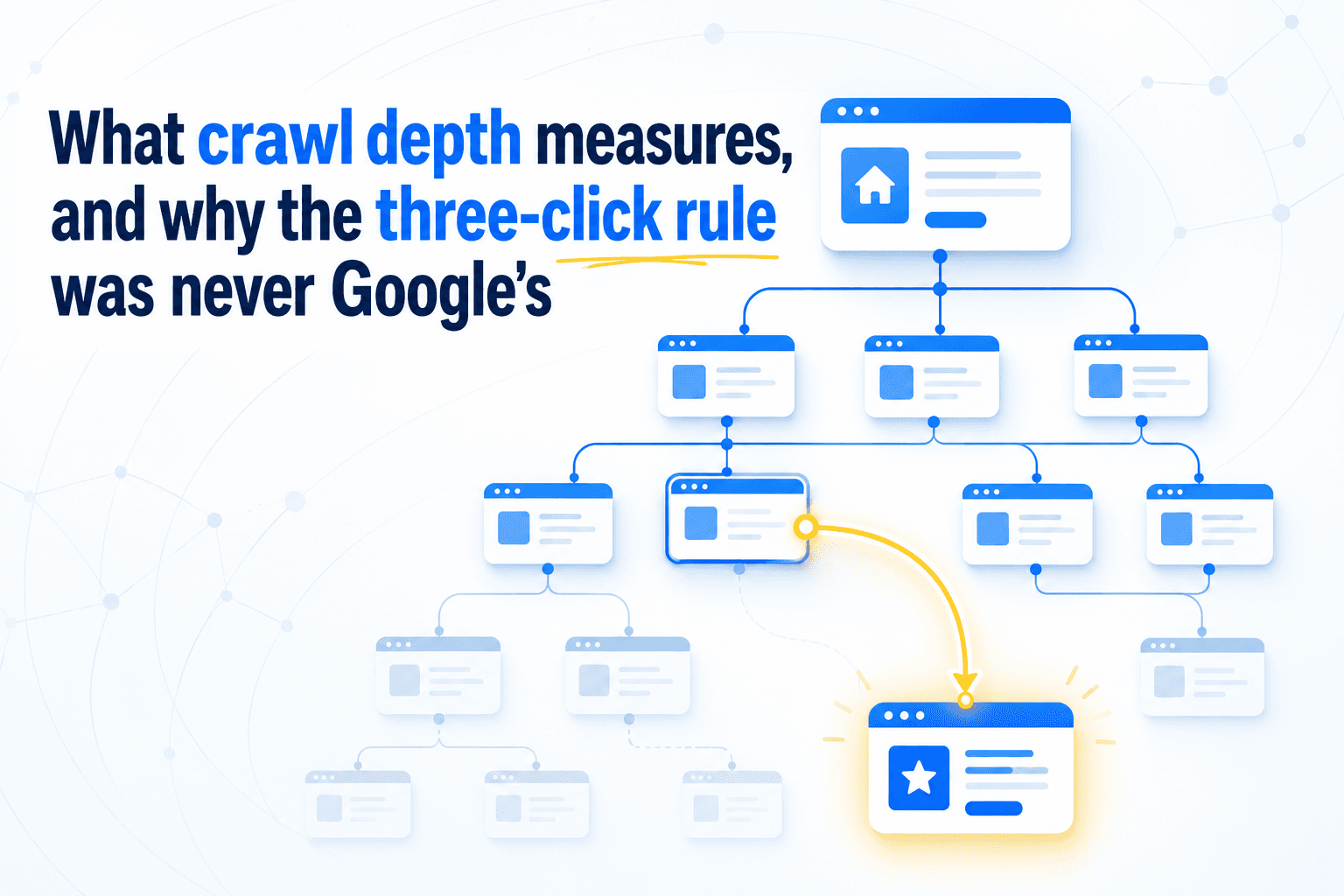
Crawl depth is the number of clicks on the shortest internal path from the crawl's starting page to a given page. The homepage sits at depth 0, pages linked directly from it at depth 1, and so on. When several paths lead to the same page, only the shortest one counts.
In Screaming Frog, the figure sits in the Crawl Depth column of the Internal tab, with a filter in the Links tab isolating the deepest pages.
The number measures your internal link graph. It does not measure what Google does.
Three things that quietly change your number
- Redirects count as a level. Screaming Frog's documentation confirms it, so a page behind two redirects reports two clicks deeper than a visitor experiences it.
- The crawl starts where you point it. Depth is calculated from the start URL, not the homepage by definition, so launching from a category page shifts every figure.
- Googlebot has other doors. It also finds URLs through XML sitemaps, external links, and URLs already on file. Your crawler follows internal links and nothing else.
Pages with no internal link pointing at them never appear in the crawl at all, which makes orphan pages a separate diagnosis rather than an extreme depth value.
Click depth is not URL depth
Two different numbers get called depth, and readers routinely mix them up. Click depth counts links traversed. URL depth counts slashes in the path. A page at /blog/technical/crawling/depth/ looks four levels deep, but if the homepage links straight to it, its click depth is 1.
| Click depth | URL depth | |
|---|---|---|
| What it counts | Links traversed on the shortest internal path | Subfolders in the URL path |
| Where it appears | Crawl Depth column | Folder Depth column |
| Worth optimising | Yes, on selected pages | No |
The tool producing the number says so itself: Screaming Frog describes Folder Depth as useful for segmentation and not an SEO metric to optimise.
Google's position matches. In a Search Central hangout in March 2021, John Mueller said there is no benefit to an artificially flat URL structure, and that Google does not tally slashes to decide a page is less visible.
Restructuring URLs to look shallower costs you a redirect migration and buys nothing.
Where the number three came from
The three-click rule was not a search engine guideline. Jeffrey Zeldman put it in print in his 2001 book Taking Your Talent to the Web, arguing that users who cannot find something within three clicks will go elsewhere. He offered no research behind it, and two years later a usability study found none.
In April 2003, Joshua Porter published Testing the Three-Click Rule at User Interface Engineering. His team analysed 44 users attempting 620 tasks, more than 8,000 clicks, looking for the drop-off the rule predicts.
- No correlation appeared between click count and task success. Successful and failed paths had the same length distribution.
- It took 15 clicks before 80% of tasks were completed. Hardly anyone stopped at three.
- Dissatisfaction stayed between 46% and 61% regardless of path length. Shorter paths did not produce happier users.
Porter also described what believing the rule leads designers to do: put global navigation on every page, and make the hierarchy shallow and wide. That is the mega menu, identified as a consequence of the rule twenty-three years before SEO adopted it as a fix.
Porter measured humans completing tasks, not crawlers fetching URLs, so his study says nothing about Googlebot. What it establishes is narrower and still decisive: the number three never had evidence behind it.
What Google says, and when depth actually matters
Google has endorsed the principle while never endorsing a number. In a 2018 Webmaster Central hangout, John Mueller said the count of slashes in a URL does not matter, and that what does matter is how many clicks separate a page from the homepage, because a page one click away reads as more important.
So shallow does signal importance. The open question is whether depth does the work or stands in for something else.
Site size decides whether the question is even live. Google's crawl budget guide names who it is written for:
- Sites above 1 million unique pages with content changing roughly weekly
- Sites above 10,000 unique pages with content changing daily
- Sites where a large share of URLs sit in Discovered, currently not indexed in Search Console
Below those thresholds, Google's instruction is to keep the sitemap current and check index coverage. That is the whole recommendation.
Crawl budget and internal linking interact on separate terms past a few hundred thousand URLs, where the crawler starts rationing what it fetches.
At scale, the pattern is real. Botify's crawl coverage data by depth shows near-total coverage is rare beyond depth 3, with the crawled proportion declining steadily as depth increases.
The same platform supplies the confounder. Its analysis of page depth as a ranking factor notes that deep pages carry less internal PageRank because they are linked to less often, and that deep pages sometimes carry high internal PageRank when they are heavily linked.
Depth and inlink count usually move together, and when they come apart, the links decide. No public test isolates the two variables, so the relationship stays correlational.
This is why depth alone makes a poor shortlist. The page worth finding has commercial value and three inbound internal links, the gap Unveil SEO surfaces by reading the meaning of every paragraph on a site.
That reframes the entire job. You are not correcting a site-wide number, you are correcting a list.
Reduce depth on the pages that matter, not across the site
Depth is how a site states priority, so flattening it removes the vocabulary instead of fixing the sentence. The output of a depth analysis is a shortlist of perhaps twenty pages, lifted by contextual links placed in relevant body content, with the site's average depth left where it is.
Depth is the vocabulary, not the defect
Priority is relative. A site can only say that one page matters more than another by treating them differently, and depth is one of the few structural ways it has to do that.
Push that to its limit. A 50,000-product catalogue with everything at depth 2 requires a homepage carrying 50,000 links, at which point the homepage has stopped saying anything about any of them.
So the useful question is never whether your depth is too high. It is whether your depth matches what you actually want ranked.
Why flattening through navigation fails
Do the arithmetic. A 5,000-page site adding twelve menu items creates 60,000 new internal links, twelve on every page, distributed with perfect uniformity.
The average depth falls. The ranking of your pages by internal link count does not move at all, because every page received the same increment.
You raised the floor, not the ceiling.
A navigation anchor also reuses one fixed label across the whole site, so it cannot describe its destination differently depending on where the reader is standing.
This is the design consequence Porter named in 2003.
Which pages to lift
Three criteria together, never depth on its own:
- Commercial or strategic value. The page has to be worth a link before anything else matters.
- Low internal inlink count. Sort by the Inlinks column, or by Link Score if you have run crawl analysis. A page at depth 6 with forty inbound links is not your problem. A page at depth 3 with two is.
- Depth above your site's working norm. Norm, not three. On a 400-page site, depth 4 is unremarkable.
Keep the list short, for the same reason the plateau fails. Priority declared for every page is priority declared for none, and a list of 300 pages is a second navigation menu wearing a spreadsheet.
How to place the link
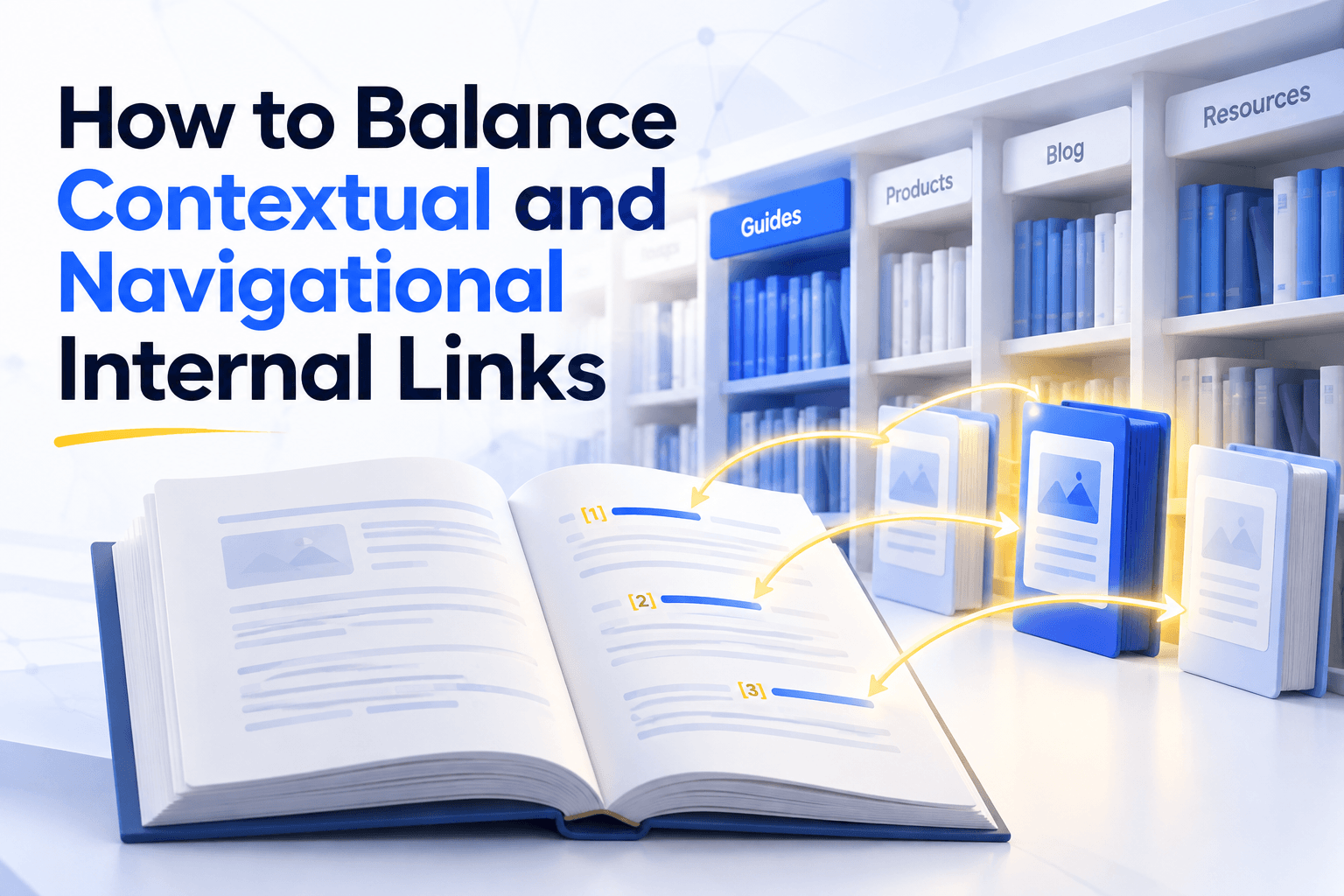
A contextual link exists only where a paragraph is genuinely about the subject. That constraint is what makes it work: its distribution is uneven by construction, so it carries information a sitewide link cannot.
The anchor does the other half.
Bolted: "We also cover pagination issues. Click here to read more."
Woven: "Faceted navigation on large e-commerce sites generates URL combinations that push product pages several levels deeper than the category structure suggests."
Same destination, same click. The second anchor tells Google and the reader what sits on the other side, which is the part carrying weight. Unveil SEO does this at scale, locating the paragraphs where a link is warranted and writing anchors an editor would have written.
Then measure the right number. Re-crawl and check the inlink count on your shortlist, not the site-wide depth average.
If that average moved a lot, you flattened again. A fix that worked is close to invisible in the aggregate, and that is the point.
A systematic internal link audit repeats the selection on a schedule, which keeps the shortlist current as pages are added.