
The study at a glance. We sorted the 60,926 internal links received by 1,804 articles on the blogs of six software vendors for trade businesses. We then matched these articles with 21,062 rankings on Google France and with their citations in AI Overviews, from July to October 2026.
Our finding fits in one sentence. An article tied into the rest of the blog by at least one incoming and one outgoing link placed in the text, what we call contextual internal linking, is more visible on Google and in AI Overviews alike.
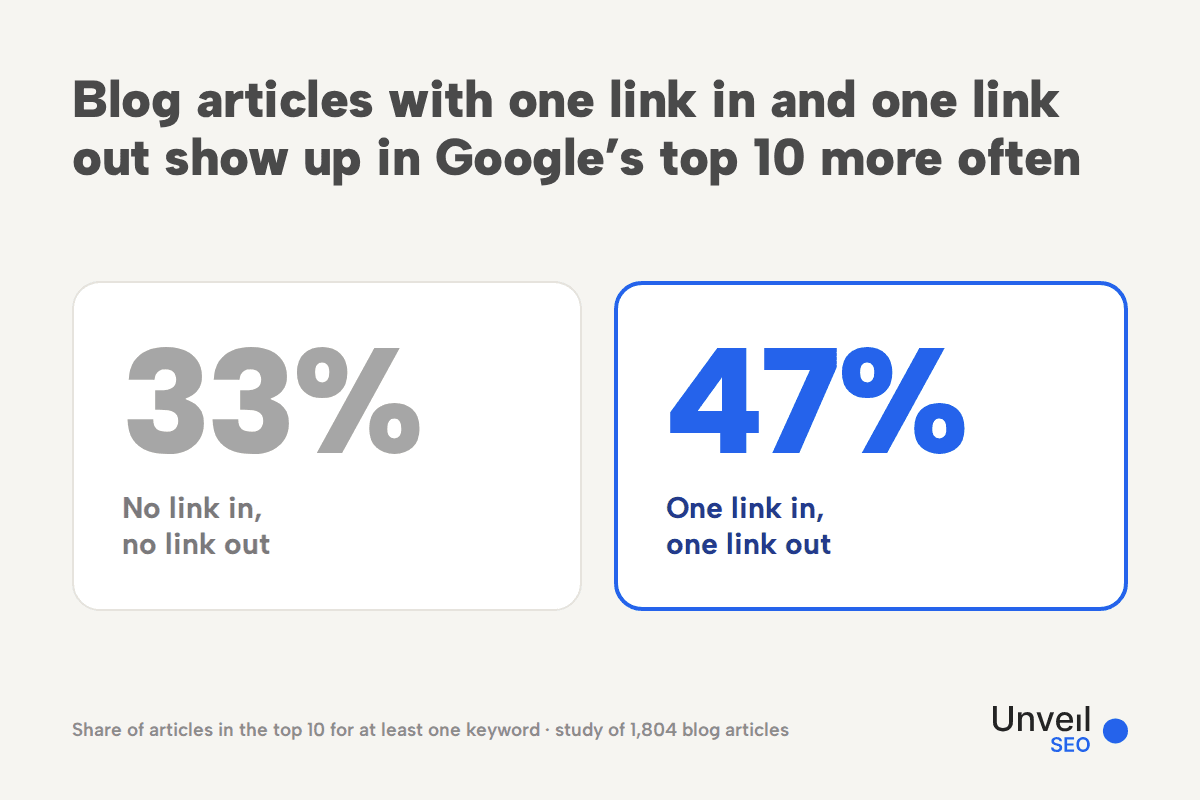
- It shows up in Google’s top 10, for at least one keyword, 47% of the time, versus 33% for an article that neither receives nor gives such a link.
- It ranks for more than 50% more keywords.
- It is cited in Google’s AI Overviews 1.6 times more often.
- These gaps are of the same order as a first backlink’s.
- Nearly one article in two receives no contextual link from another article, or gives none.
These gaps compare similar articles, of comparable length, age and backlinks, on the same blog. So they don’t simply come from linked articles being longer, older or better backlinked.
They show an association, not yet proof of an effect.
For a content team, the first move is to link isolated articles, both ways. The full method is at the end of the article.
On Vertuoza’s blog, two articles have almost everything in common. Each runs about 2,000 words, and both went online around the same time.
The first, “Qu’est-ce que le fonds de roulement ?” (What is working capital?), receives a link placed in the text of another article on the blog. Over the study period, it ranks for 20 keywords on Google. The second, “Les étapes du nettoyage de fin de chantier” (The steps of end-of-job site cleanup), receives none and doesn’t show up for a single query.
One pair of articles proves nothing, since their topics differ too. Still, it illustrates a question we are often asked. Do one incoming and one outgoing link, placed in the text, change how visible an article is?
At Unveil SEO, our platform builds this contextual internal linking on any website. We wanted to measure what it changes, across 1,804 articles from the blogs of six software vendors for trade businesses.
We picked these six blogs, those of Obat, Intia, Organilog, Archipad, Costructor and Vertuoza, because they are mid-sized and get few backlinks. On large, heavily cited sites, links from elsewhere would have hidden the role of internal linking. We kept only their blog pages, leaving out product, pricing and feature pages.
The answer fits in one number. At a comparable profile, an article that receives and gives at least one of these links shows up in Google’s top 10 47% of the time, versus 33% for an article that neither receives nor gives any.
To show up on Google, a link in the text goes further than a link from a listing page
Before comparing anything, we had to be clear about which links we were talking about. On an article page, internal links come in two families.
Contextual links are written by the editorial team, in the text, a list, a table or a “See also” box. Structural links are added automatically to every page, from the navigation to the footer, by way of the breadcrumb, suggested articles and the article lists on the blog’s listing pages.
Diagram of an article page, with contextual links in blue in the text and structural links in grey.
We separated these two families for two reasons. Contextual links are the ones an editorial team chooses, and they are also the ones that say the most. We suspected they matter for SEO as much as for visibility in AI, without knowing how to measure it.
Structural links, on the other hand, are almost identical from one article to the next on the same blog. So they can’t explain why one article ranks better than another, which doesn’t make them useless.
Sorting the links took time, and the result is a lesson in itself. Our crawler collected 362,728 internal links across the six sites. The 1,804 articles in the study receive 60,926 of them, a median of 19 per article.
Remove the navigation, footers and sidebars, and 10,087 remain in the content area. Set aside the links from the blog’s listing pages, the homepage and reading suggestion blocks, and 6,175 contextual links are left, 5,775 of which connect two articles in the study.
Of the 60,926 internal links received by the articles, about one in ten is a contextual link.
In other words, about one in ten of the links an article receives was put there by someone, in the text. Everything else comes from the site’s template.
Does that tenth make a difference? A first comparison suggests it does. To appear in Google’s top 100 results, receiving a contextual link goes with 8 more points, while a link from a blog listing page goes with no measurable gap.
An article linked only from listing pages is therefore not really linked. The next question was in which direction contextual links count.
Receiving a link and giving one each go with better results
A contextual link has two ends. An article can receive links from other articles, give links to other articles, or both, which makes four profiles.
- Linked both ways, when it receives at least one contextual link from another article and gives at least one
- Gives only, when it links to other articles without receiving any links
- Receives only, when it receives links without giving any
- Isolated, when it neither receives nor gives a contextual link
It doesn’t take much to change profile. Our comparison sets articles with no contextual link in one direction against those with at least one, and a single link is enough to move from one side to the other.
An isolated article isn’t an orphan page in the usual sense, since it can still be reached through the menu or the blog’s lists. It is simply that no other article recommends it in its text.
Both directions count, each in its own way. At a comparable profile, receiving a contextual link goes with 6 more points of presence in the top 10, and giving one with 8 more points. For the number of keywords, receiving a link goes with 19% more, giving one with 31% more.
Share of articles in Google’s top 10 by contextual links, from 33% for an isolated article to 47% for one linked both ways.
Articles get the best results when they combine the two. An article that receives links without giving any already does better than an isolated one, and so does one that gives links without receiving any, but neither reaches the level of an article linked both ways. What remained was to measure what the latter is worth overall.
Linked both ways, an article is more visible on Google and in AI Overviews
We measured this visibility in three ways, presence in the top 10, the number of keywords and citations in Google’s AI Overviews. On all three, the gap points the same way.
An article linked both ways outperforms an isolated one on top 10 presence, keywords and AI Overview citations.
It shows up in Google’s top 10 more often
Take 100 isolated articles. Over the study period, 33 of them appear in Google’s top 10 for at least one keyword. Now take 100 articles linked both ways, comparable in length, age and backlinks, on the same blogs. There are 47 of them.
The 14-point gap is one of the clearest in the study. Like any measurement made on a sample, it comes with a margin of uncertainty, which here runs from 8 to 19 points. Even at the bottom of that margin, the gap remains clear.
Why the top 10, and not the top 3? Too few of our articles reached the first three spots to draw a conclusion. That will be the subject of a future study, run on better-ranked sites.
It ranks for more than 50% more keywords
Where an isolated article ranks for 10 keywords, an article linked both ways ranks for about 16, at a comparable profile. That is 56% more keywords. Across our 1,804 articles, we recorded 17,151 different keywords in total.
A ranking isn’t a visit, especially beyond the first page. But each keyword is one more way in to the article, on a query where it can be found.
It is cited 1.6 times more often in Google’s AI Overviews
AI Overviews are the answers Google’s AI displays at the top of many results pages, citing their sources with links. Over the study period, we recorded 3,288 citations of our articles, in 3,131 AI Overviews.
22% of isolated articles were cited at least once, versus 35% of articles linked both ways, at a comparable profile. An article linked both ways is therefore cited 1.6 times more often.
Do writers simply link their best articles first?
That is the objection any careful reader raises. It surely happens, but several elements of the study make it unlikely to be the only explanation. The comparison already neutralizes the usual marks of a good article, its length, its age and its backlinks. And giving links goes with better results just as receiving them does, which a simple choice of the best articles as link targets explains poorly.
Our data still can’t rule this reading out, especially since the links were collected after the rankings. That is the study’s main limitation, and the next measurement will help settle it.
Examples the other way around exist, too. On Obat’s blog, “Quel est le nombre de jours travaillés en 2025 ?” (How many working days are there in 2025?) receives no link from another article and still ranks for 237 keywords, carried by a seasonal topic and by its backlinks. A link isn’t everything, which is exactly why we compare articles with a comparable profile.
Fourteen points for the top 10, thirteen for citations. Are these gaps large or small? To judge, we needed a point of comparison.
These gaps are of the same order as a first backlink’s
The lever every SEO knows is the backlink, a link from another site. So we measured, on the same articles and at comparable length, age and blog, what the first one changes.
| Gap, in points | Linked both ways, vs isolated | First backlink, vs none |
|---|---|---|
| In the top 10 | +14 (8 to 19) | +19 (14 to 24) |
| Cited in an AI Overview | +13 (8 to 20) | +20 (15 to 25) |
The margins of uncertainty of the two gaps, in brackets, overlap, so our data can’t tell which one weighs more. They are of the same order. That doesn’t mean an internal link is worth a backlink, but that on these blogs, both go with comparable gaps.
GThe gap associated with being linked both ways is of the same order as a first backlink’s.
On these blogs, backlinks are rare anyway. Three articles in four receive none (76.5%, according to DataForSEO’s index), and 57% of those that have any have only one. For most of these articles, internal linking is therefore the only link lever available.
Nor do the two levers take the same effort. Depending on the site’s visibility and the type of link, getting a backlink costs anywhere from a few tens of euros for a simple placement to several thousand for a well-known media outlet, not counting the time spent landing it. Linking two articles on the same blog takes a few minutes, and with Unveil SEO it is even faster and happens across the whole site.
This is reasoning, not a measurement, but it changes the order of priorities. Before investing in a first backlink for an article, it makes sense to check first that the article is linked to the rest of the blog. The remaining question was how many articles already benefit from this lever.
Nearly one article in two receives or gives no contextual link
The answer leaves plenty of room. Of the 1,804 articles, 854 are not linked both ways. 297 are completely isolated, 430 point to other articles without any pointing back, and 127 receive links without giving any.
854 of the 1,804 articles, nearly one in two, receive or give no contextual link.
The shortfall is mostly on the receiving side. 727 articles receive no link from the text of another article, versus 424 that give none.
This finding holds for these six blogs, and we don’t yet know whether it holds elsewhere. But on these blogs, the potential lies in content already published. There is no article to write, only links to place between articles that already exist.
Link every article with at least one incoming and one outgoing link, in the text
The work takes a few steps and starts with a list, that of the blog’s articles and the contextual links each one receives and gives. It is the foundation of any internal link audit.
- 1
List the blog’s articles
Start from the blog pages only, without product pages or listing pages.
- 2
Count the contextual links received and given
For each article, count the links placed in the text of another article, and those it places toward other articles. Leave out the menu, the footer, automatic suggestions and the blog’s listing pages.
- 3
Rank the articles by priority
Start with isolated articles, then those that receive no link, then those that give none.
- 4
Add one incoming and one outgoing link
Place each link in the text, where the other article’s topic comes up naturally. The anchor, meaning the clickable text, describes what the destination page covers, as Google’s guidelines on links recommend.
- 5
Track the change
Note the date, then track the keywords, rankings and AI Overview citations of the linked articles. Leaving a few comparable articles untouched helps separate the effect from the blog’s overall trend.
For a few dozen articles, a spreadsheet will do. Beyond that, Unveil SEO does this sorting automatically, telling contextual links apart from structural ones, surfacing isolated articles and suggesting incoming and outgoing links for each.
The questions we want to settle
This study answers one question and opens several others. On each of them, our six blogs lacked the volume to conclude, and we would rather say so than force an answer.
These questions fall into groups, depending on how we plan to answer them.
- A new measurement on the same articles, in a few months. It is the most important one, because it will show whether articles that gain links go on to gain visibility, and so which way the relationship runs.
- Larger sites, with more links per article. They will show whether the link text, the anchor, matters, and how many links are needed beyond the first.
- Better-ranked sites, to find out whether contextual internal linking also helps reach the top 3.
- Other sites and other sectors, e-commerce included. They will show whether the gap varies from one site to another, whether a link in the text beats a “related articles” block, which only 90 of our articles received, and whether the menu counts when it changes from page to page.
The anchor question interests us in particular. Zyppy’s study of 23 million internal links found a strong association between anchor variety and clicks from Google, without separating menu links from links in the text.
We will update this article at each step.
Method and data
The links of 1,804 articles from six blogs were collected by the Unveil SEO crawler, then matched with the rankings and citations recorded by DataForSEO. Articles are compared at similar length, age, backlinks and blog, and only statistically significant results are presented.
The sites and the articles
The six blogs studied are those of Obat, Intia, Organilog, Archipad, Costructor and Vertuoza, French software vendors serving trade businesses. The 1,804 articles were identified among their editorial pages, excluding product pages and listing pages.
Three other crawled sites were set aside, for lack of links between articles or because their market was mostly outside France. A fourth blog, inactive for three years, was dropped before the crawl.
The sources
| Data | Source |
|---|---|
| Internal links | Unveil SEO crawler, October 25, 2026 |
| Google France rankings | DataForSEO Labs, July to October 2026 |
| AI Overview citations | DataForSEO, July to October 2026 |
| Backlinks | DataForSEO Backlinks, referring domains excluding spam |
| Article age | First capture in the Wayback Machine |
Backlinks are counted as referring domains. Of the 2,703 domains counted, 641 distinct domains were reviewed one by one to rule out spam, those of the 26 most exposed articles.
How links were classified
Links were classified with rules, based on their position on the page, how closely they match the page’s title and the form of their anchor. This classification was checked by eye on samples and on real pages.
How articles were compared
Each result comes from a logistic regression at similar length, age, backlinks, content type and blog. The 95% ranges come from resampling the articles within each blog.
Age weighs heavily in rankings. Ahrefs’ study of how long it takes to rank found that most pages in Google’s top 10 have been online for years.
Without neutralizing age, part of the advantage of older articles, which have had time to collect links, would be credited to internal linking. That is why no figure in this study is presented without this comparison.
Results by profile
| Profile | Articles | Top 10 | Top 100 | Cited in an AI Overview | Keywords, base 100 |
|---|---|---|---|---|---|
| Isolated | 297 | 33% | 54% | 22% | 100 |
| Gives only | 430 | 41% | 68% | 29% | 131 |
| Receives only | 127 | 40% | 63% | 27% | 119 |
| Linked both ways | 950 | 47% | 75% | 35% | 156 |
The top 100 is a secondary measure. An article linked both ways appears in the top 100 results 75% of the time, versus 54% for an isolated one (+21 points, 14 to 28).
Robustness
The result holds across the variants tested. The gaps below set an article linked both ways against an isolated article.
| Variant | Top 100 | AI Overviews |
|---|---|---|
| Reference | +21 points | +13 points |
| Articles only, no tools, templates or videos | +21 | +15 |
| Without pages never archived | +25 | +15 |
| Without Obat | +23 | +12 |
| Without Organilog | +21 | +19 |
| Without Costructor | +23 | +14 |
| Age in months rather than thirds | +26 | +16 |
Limitations
- The study shows an association, not proof of an effect, and the links were collected after the rankings.
- It covers six blogs from a single sector.
- Rankings are estimated by DataForSEO, which ignores queries with fewer than about ten searches a month.
- Citations are those DataForSEO detects in AI Overviews.
- Article age is measured roughly, from the first Wayback Machine capture.
Cite this study
Unveil SEO, Contextual internal linking and Google visibility, a study of 1,804 articles from the blogs of six software vendors for trade businesses, October 2026, [article URL]. The charts may be reused freely, with a link to this page.