
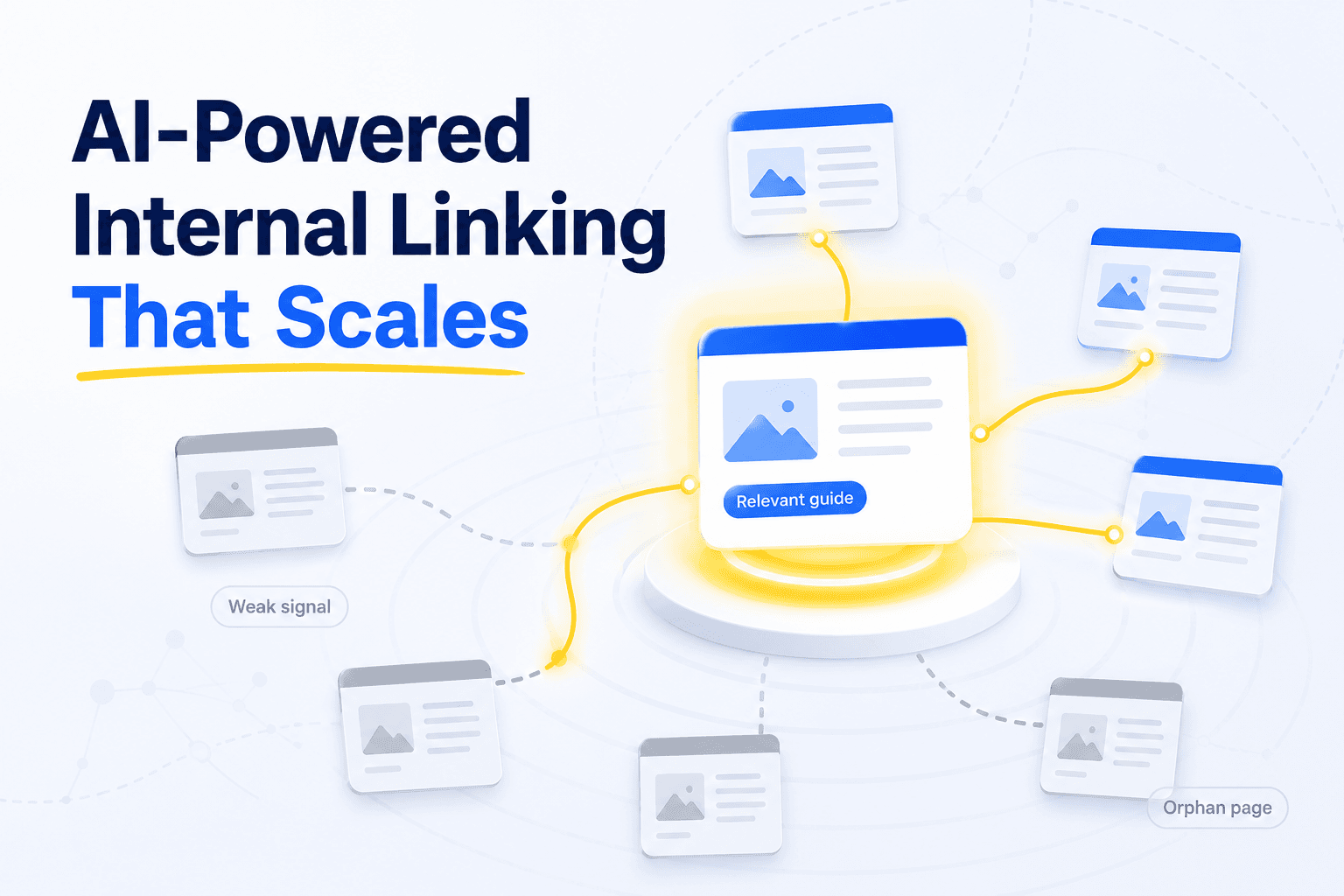
A site with 500 pages has 250,000 possible link combinations. You are not going to evaluate them manually.
But full automation without oversight creates a different problem: irrelevant links, robotic anchors, over-linked pages. The question is not "should I automate?" It is: how much intelligence does the system need to make good suggestions?
The answer depends on which level of automation you use. Each one changes what the system can see and understand.
What manual linking does well (and where it breaks)
You know your content. You read a paragraph, you know which page to link. That is the best possible matching. It just does not scale.
This works when you have 30-50 pages in your head. You remember what exists, you see the connections.
Past a few hundred pages, you stop knowing. You link to what you remember, not to what's most relevant. And you never think to go back to old articles to add links toward new ones.
The matching quality is high. The coverage is not.
What changes when AI does the matching
The shift from keyword matching to semantic matching is not a speed improvement. It is a fundamentally different kind of analysis. Traditional tools match vocabulary. AI understands meaning.
Traditional internal linking tools (Yoast, Semrush) work by keyword matching. If page A contains "internal link audit" and page B targets that keyword, the tool suggests a link.
Fast, but shallow. It catches exact overlaps and misses conceptual relationships.
LLM-based matching works differently. It reads the paragraph, understands the argument being made, and evaluates whether a link fits the reasoning.
| Dimension | Keyword matching | Semantic matching (LLM) |
|---|---|---|
| What it reads | Individual words and phrases | Full paragraphs and their meaning |
| How it matches | Exact or partial keyword overlap | Conceptual proximity between ideas |
| Anchor suggestion | Repeats the target keyword | Generates an anchor that fits the sentence |
| What it misses | Pages that cover the same concept with different words | Very little, if the content is well-written |
A keyword tool sees that "crawl efficiency" and "crawl budget" share a word.
An LLM understands that a paragraph about Google skipping deep pages relates to an article about how internal links control what Google crawls. Neither phrase has to appear in the other.
Classical SEO treated internal links as equity conduits: pipes for PageRank. Even that model was never as uniform as it sounds. Google's Reasonable Surfer patent already weighted links by how likely a user was to click them, rather than treating every link on a page the same.
AI retrieval works on a different signal entirely. It matches the meaning of a query to the meaning of a passage using embeddings (numerical representations of what content is about, not the words it contains). That's one reason AI citations track classical rankings so loosely. In a 15,000-prompt analysis, only 12% of the pages cited by ChatGPT, Gemini, and Copilot also ranked in Google's top 10 for the same query.
Keyword-matched links carry less of this signal than semantically relevant ones.
What you can do with AI yourself
An LLM like ChatGPT or Claude is a surprisingly effective internal linking assistant. For small-to-medium sites, it covers a lot of ground.
Here is what works well:
- Upload a crawl export (titles, URLs, inlink counts) and ask for a full linking audit. The LLM finds opportunities, suggests placements, and proposes contextual anchors.
- Paste an article alongside your list of page URLs and ask "where should I add internal links, and to which pages?" The LLM suggests where each link fits in the text.
- Cross with GSC data: export impressions and position, paste alongside your page list, ask "which underlinked pages have the most ranking potential?"
This is real, useful work. For a 50-page blog, DIY AI can handle most of your internal linking needs.
Where it hits limits:
- It only sees what you feed it. The LLM cannot detect pages you forgot to include, orphan pages it has never seen, or gaps in a cluster it doesn't know exists. There is no persistent view of your site between sessions.
- Feeding it more pages gets expensive fast. Fifty pages fit comfortably in a single prompt. A 500-page site means re-pasting that same volume on every audit, burning through context limits and token costs before a single suggestion comes back.
- It can invent. The LLM may suggest URLs that don't exist or titles that don't match your actual content. Every suggestion needs verification.
DIY AI gives you LLM-quality matching on whatever you put in front of it. What it lacks is the full picture.
What a dedicated tool adds
A dedicated tool like Unveil SEO gives the AI two things DIY cannot: a complete view of every page on your site, and far more precise matching between them.
The difference is not the intelligence. It is the input.
When you paste 20 pages into ChatGPT, the LLM does its best with 20 pages. When Unveil SEO crawls your site and generates embeddings for every page, the matching happens across your entire corpus simultaneously.
What that enables:
- Inbound suggestions. Not just "where should this page link to?" but "which existing pages should link to this page?" This is the direction DIY AI struggles with most, especially for orphan pages and new content.
- Semantic cluster view. See how your pages group by meaning, where the bridges between clusters are missing, and which clusters are isolated.
- Orphan, dead-end, and depth detection. Automatically identify pages with zero inbound links, pages that receive authority but don't redistribute it, and pages buried too deep in your architecture.
- Prioritization. Score opportunities by potential impact so you fix the highest-value gaps first.
- Precision at scale. Embeddings computed across all pages means the tool doesn't just find "related" pages. It finds the most semantically relevant match out of every page on your site.
The core advantage is structural: Unveil SEO sees your whole site as a connected graph, not as isolated pairs of pages. That changes the quality of every suggestion it makes.
Where automation should stop
AI suggests. Humans approve. Fully automated link injection without review degrades quality, for readers and for anything trying to extract a clean answer from the page.
Some tools offer one-click injection: the AI finds opportunities and inserts links directly into your CMS. This saves time but introduces risk:
- Links placed in paragraphs where they break the reading flow
- Anchors that are technically relevant but contextually awkward
- Over-linking: the same target page receiving 30 new links from template-generated suggestions
The right model:
- ✓ Automate: opportunity discovery, anchor text suggestions, orphan detection, cluster mapping
- ✓ Automate: prioritization (which fixes matter most)
- ❌ Keep human: final approval of each link, anchor wording in context, editorial judgment on whether the link serves the reader
That review step matters for AI agents that browse your site too, not just human readers. A well-placed contextual link is a navigation path an agent can follow. A page cluttered with 30 near-identical links is harder to parse, for a person skimming or a system retrieving a clean passage to cite.
Before an AI-suggested link goes live, apply the same test you'd apply to a paragraph you wrote yourself. Does it belong here, or was it just easy to add?