
Most sites have content on similar topics. Very few have structure.
The difference is not how much you publish. It is whether your pages teach anything to the systems crawling them.
A site can have fifty articles on SEO and still look, to a search engine, like fifty strangers in a room. The question is not "do we have internal links?" It is: do our links explain how our pages relate to each other?
Semantic clusters are the answer to that question. Not because they organize your content calendar, but because they make every linking decision deliberate.
What a semantic cluster actually is
A semantic cluster is a group of pages that collectively cover a topic with enough depth and internal coherence that a search engine can recognize the site as an authority, not just a collection of posts.
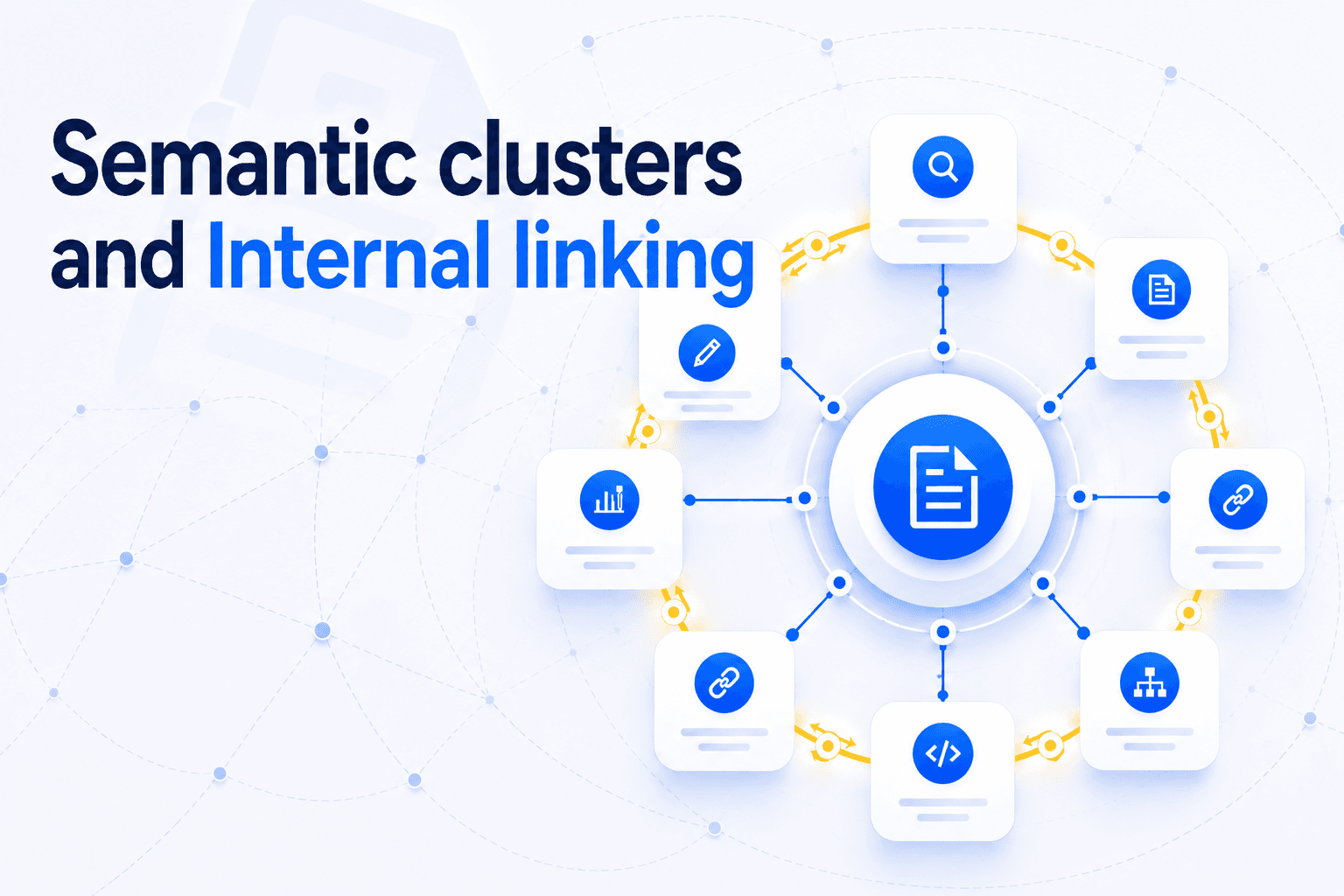
The most common way to describe a cluster is "pillar plus spokes." One broad page at the center, several deeper pages orbiting it.
That structure is correct, but it misses the mechanism. The spokes are not just topically related to the pillar: they are semantically adjacent to each other.
A cluster on content marketing might include a spoke about editorial calendars, another about repurposing content, another about measuring performance. Each of those pages is close to the others in meaning, not just in subject.
What ranks is not a single page. It is the cluster the page belongs to.
A single well-written article on internal linking is a good page. That same article, sitting inside a coherent cluster of pages on link building, SEO architecture, and site structure, is a signal. Search engines see not just the page, but the web of related content around it.
The three components of a cluster
| Component | Role |
|---|---|
| Pillar page | Covers the topic broadly, links to every spoke |
| Spoke pages | Cover one subtopic each, link back to pillar and to adjacent spokes |
| Linking structure | Bidirectional: every relationship goes both ways |
A brief history most SEOs don't know
French consultant Laurent Bourrelly published the cocon sémantique methodology in 2004, thirteen years before HubSpot popularized "topic clusters" at Inbound 2017. Bourrelly's approach was built on semantic proximity in linking, not just content grouping. The goal was to wire pages together based on how close they were in meaning, so that crawlers traversing the link graph would perceive a coherent thematic structure.
Sylvain and Guillaume Peyronnet later refined this into an explicitly algorithmic version. Their Cocon SEO approach uses semantic vector proximity to calculate which pages should link to which, at scale.
The French SEO community has been doing algorithmically what HubSpot turned into a brand framework. The anglophone world got the name. The French got the methodology.
How search engines read a cluster
When Googlebot crawls your site, it doesn't evaluate pages in isolation. It follows links, maps relationships, and infers which pages belong together. The cluster structure you build determines what it concludes.
A site that demonstrates comprehensive, interlinked coverage of a subject signals something fundamentally different from a site that has one well-optimized page.
The crawl logic works like this: a crawler lands on a page, reads the content, then follows outbound links to understand what the page considers related. If those links consistently point to pages within the same semantic territory, with anchors that describe the destination accurately, the crawler builds a map of topical coherence.
If those links are scattered, the map stays blurry.
This is where most sites lose the signal. A link in a menu tells a crawler a page exists. A link woven into the body of an argument tells a crawler what that page means.
The anchor text is how a search engine learns what the destination covers. An anchor like "click here" teaches nothing. An anchor like "flat site architecture" tells the crawler exactly what it will find on the other side.
A 2025 analysis of 2.5 million contextual internal links across 1,700 real websites (LinkStorm) found that nearly half of in-body links show minimal semantic overlap between the anchor text and the target page's topic. Most "contextual" links are navigational links placed in body copy. They check a box without building a signal.
Here is what the difference looks like in practice:
❌ Bolted on (the link is detached from the argument): "Internal linking is an important part of any SEO strategy. Read our guide to site architecture to learn more."
✓ Woven in (the anchor is part of the sentence's meaning): "Pages buried more than three clicks from the homepage rarely accumulate enough internal link equity to compete for competitive terms, which is why flat site architecture is the structural prerequisite for any cluster strategy."
Same destination. The second link teaches the crawler what "flat site architecture" means in relation to the surrounding argument. The first just opens a door.
A study of 23 million internal links (Zyppy) found that pages with 40-44 internal links received four times more organic traffic than pages with 0-4. But after roughly 45-50 links, traffic declined. Sites that push past that threshold do so mostly by adding navigational links, which dilute the signal rather than strengthening it. More links is not more signal. More meaningful links is.
| Signal | Well-built cluster | Scattered site |
|---|---|---|
| Link destinations | Pages on the same topic | Unrelated pages, generic menus |
| Anchor text | Describes the target page's content | "Click here," "read more" |
| Page depth | Every spoke reachable in 1-2 clicks from pillar | Key pages buried 4+ clicks deep |
| Coverage | Topic addressed from multiple angles | Single optimized page per topic |
Why working cluster by cluster creates compounding SEO momentum
A site that tries to rank for everything simultaneously builds authority for nothing. Concentrating internal linking effort within one cluster first, until that cluster is dense and coherent, creates a compounding topical signal that outpaces scattered improvement.
The compounding effect works because authority inside a cluster is self-reinforcing.
Bourrelly's cocon sémantique methodology made this explicit from the start: every linking relationship in a cluster is bidirectional. Child links up to parent. Parent links down to child. Siblings link to each other.
When the pillar links to its spokes, and each spoke links back to the pillar and to adjacent spokes, the cluster becomes a closed loop of topical relevance. Every new meaningful link added inside the cluster increases the signal for every other page in it.
Scattered improvement does not compound. Adding a link here and there across unrelated topics produces linear gains at best. Completing a cluster produces exponential ones: once a cluster reaches coherence, it tends to attract external links naturally, and those links flow through the internal structure.
How to sequence cluster work
Rather than treating internal linking as a sitewide task, prioritize by cluster:
- Choose one cluster based on traffic potential, existing content depth, and strategic importance.
- Audit link completeness: every spoke should link to the pillar; the pillar should link to every spoke; adjacent spokes should link to each other where relevant.
- Audit anchor quality: for each link, does the anchor text describe what the target page is actually about?
- Identify orphan pages: pages on the cluster's topic that receive no internal links are invisible to search engines regardless of content quality.
- Move to the next cluster only once the first one is complete.
A cluster is complete when no page in it is an orphan, every link carries a meaningful anchor, and no major subtopic is left unaddressed.
When clusters connect, and when they should
A cluster is not a prison. When a page genuinely addresses something that overlaps with another topic on your site, linking across clusters is the right call. The only question worth asking: does this link serve the reader's next logical question? If yes, it belongs. If it's a stretch, it doesn't.
Some pages belong to two clusters simultaneously. A page on "measuring content marketing ROI" might sit at the intersection of a content strategy cluster and an analytics cluster. That page is not an anomaly: it is a bridge page. It earns links from both clusters and links back to both pillars. This is a feature of a mature site architecture, not a problem to fix.
The distinction worth making: a bridge page genuinely covers a topic that sits between two clusters. It is not a spoke that has been artificially stretched to reach a second cluster for the sake of cross-linking.
Your SEO architecture cluster might naturally link to your content strategy cluster. A page on internal linking structures could reasonably link to a page on pillar content planning. That link is not a dilution. It is a bridge, and it strengthens both clusters by showing the search engine that these topics are genuinely related.
The test is editorial, not algorithmic. Would a reader who just finished that paragraph naturally want to know more about that other topic?
✓ "The way you structure your pillar page determines how much authority flows to your spokes, which is why pillar page design is the first decision in any cluster build, not the last." A natural bridge between two clusters.
❌ "Internal linking matters for SEO. See our pricing page to get started." A navigation link masquerading as a contextual one.
Well-placed inter-cluster links are how a site's authority network expands. They are not a contradiction of cluster thinking. They are its mature expression.
Semantic clusters and AI search: why the architecture matters even more now
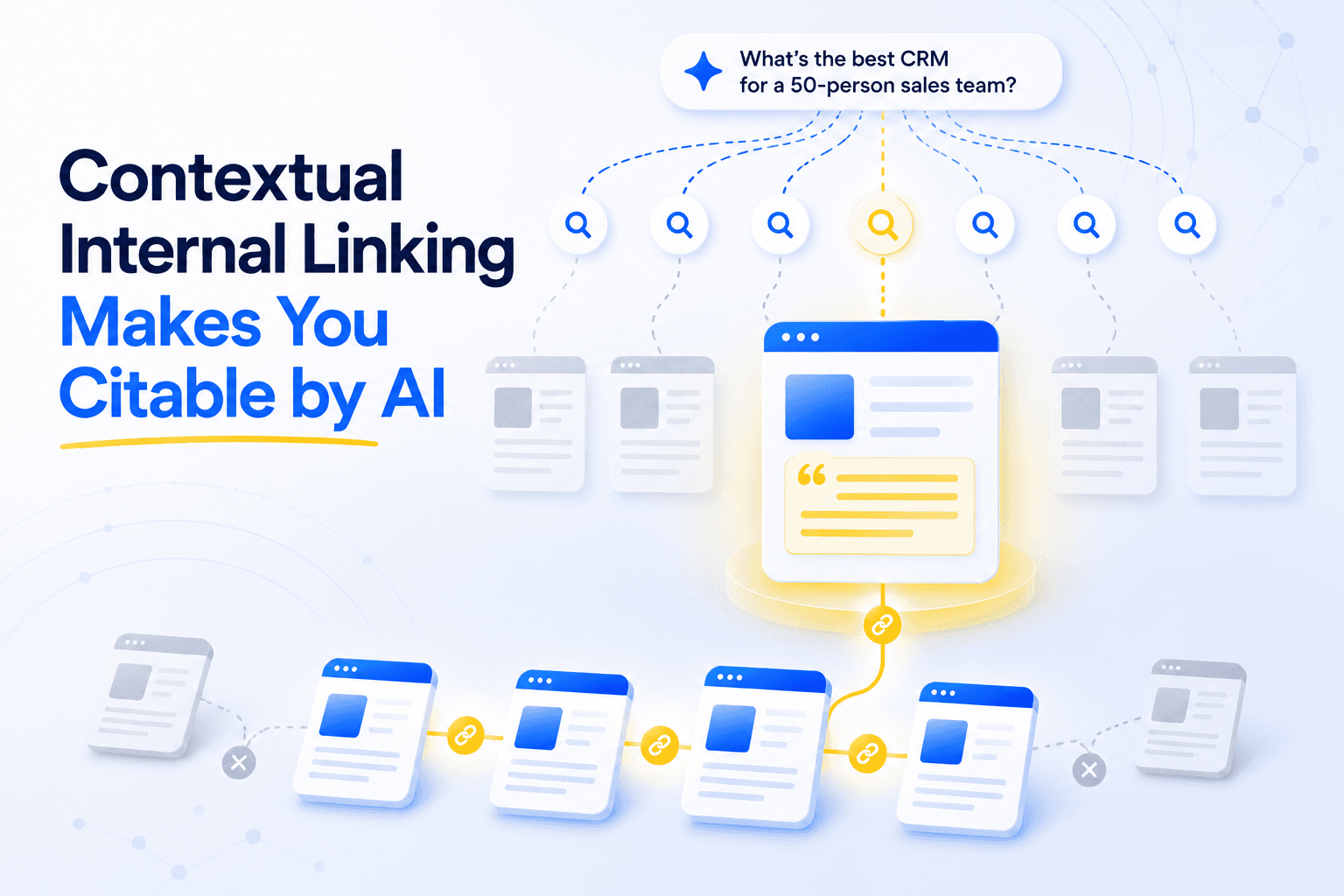
AI answer engines don't retrieve pages. They retrieve chunks. A well-clustered site, where each page answers one question comprehensively and links to related pages with descriptive anchors, is structurally optimized for how large language models actually work.
Most AI systems use a retrieval mechanism called RAG (Retrieval-Augmented Generation). The system pulls the most relevant passages from indexed sources, assembles them into context, and generates an answer. It does not read your full site. It reads specific chunks of specific pages.
The unit of visibility is no longer the page. It is the paragraph.
This changes what "well-structured content" means in practice. A page that thoroughly answers one specific question, then links to related questions with descriptive anchors, becomes a self-contained citable unit.
A page that tries to cover an entire topic in one go is harder to chunk, harder to retrieve, and harder to cite.
The data points in the same direction. An analysis of 15,847 AI Overview results found semantic completeness to be the strongest predictor of AI inclusion, with a correlation coefficient of 0.87. Pages with high semantic completeness showed 340% higher inclusion rates in AI-generated answers than those without.
Cluster depth is not just a ranking signal. It is a citation signal.
When an LLM crawler lands on a well-clustered page, the descriptive internal links around it act as navigation pathways. The system traverses the cluster, builds a richer picture of the site's expertise, and is more likely to cite multiple pages from it.
A site with dense, coherent clusters does not just rank better. It becomes a resource map that AI systems trust and return to.
What this looks like in practice
Building a semantic cluster is not a content sprint. It is an architectural decision that shapes every linking choice you make afterward.
Here is a concrete sequence:
1. Define the cluster's scope What does this cluster cover? What does it explicitly not cover? The boundary matters because it determines which pages belong inside the cluster and which belong to a bridge or a different cluster entirely.
2. Map the subtopic landscape List every specific question a reader might have within this topic. Each question that deserves its own in-depth treatment becomes a spoke page. Questions answerable in two paragraphs belong on the pillar.
3. Build or audit the pillar page The pillar covers the topic broadly: enough to introduce every subtopic and link to the spoke that covers it in depth. It earns external links and distributes authority downward. Aim for comprehensive surface coverage, not exhaustive depth on any single angle.
4. Build or audit the spoke pages Each spoke addresses one subtopic thoroughly. It links back to the pillar. It links to adjacent spokes where relevant. The anchor text for every outgoing link describes the destination accurately.
5. Check the link matrix The bidirectionality rule applies to every relationship: pillar links to spoke, spoke links back to pillar. Spoke links to adjacent spoke, adjacent spoke links back.
For each spoke, ask: does the pillar link to it? Do at least two adjacent spokes link to it? Does it link back to the pillar and to at least two adjacent spokes?
Any spoke that fails these checks is partially orphaned: it exists, but contributes weakly to the cluster signal.
Signs a cluster is working vs. signs it needs attention
| Working cluster | Cluster needing attention |
|---|---|
| Pillar ranks for broad topic terms | Pillar ranks for nothing competitive |
| Spokes rank for long-tail variants | Spokes generate no organic traffic |
| New spoke pages index within days | New spoke pages take weeks to index |
| External links to pillar grow organically | Zero external links to any cluster page |
| AI Overviews cite the site on this topic | AI systems don't mention the site here |