
Two out of three web pages have only one internal link pointing to them. That finding, from an Ahrefs crawl study analyzing billions of URLs, means most websites leave the majority of their pages functionally invisible to both search engines and users.
Meanwhile, a Zyppy study of 23 million internal links found that pages receiving 40 to 44 internal links get four times more organic traffic than pages with fewer than five.
The gap between those two facts is where most websites lose.
Not because they lack content. Not because they lack backlinks. Because the content they already have is poorly connected.
Internal linking is the mechanism that decides which of your pages get crawled, which accumulate authority, which appear in AI-generated answers, and which sit in a dead zone that nobody (human or machine) ever reaches. It is also the only major SEO lever that requires zero external cooperation. You control every link, every anchor, every connection.
This guide explains how internal links actually work (not the simplified version), what the data says about what moves rankings, and how to audit and fix your own site's linking structure with a clear priority framework.
Why Internal Links Are the Most Underused Lever in SEO
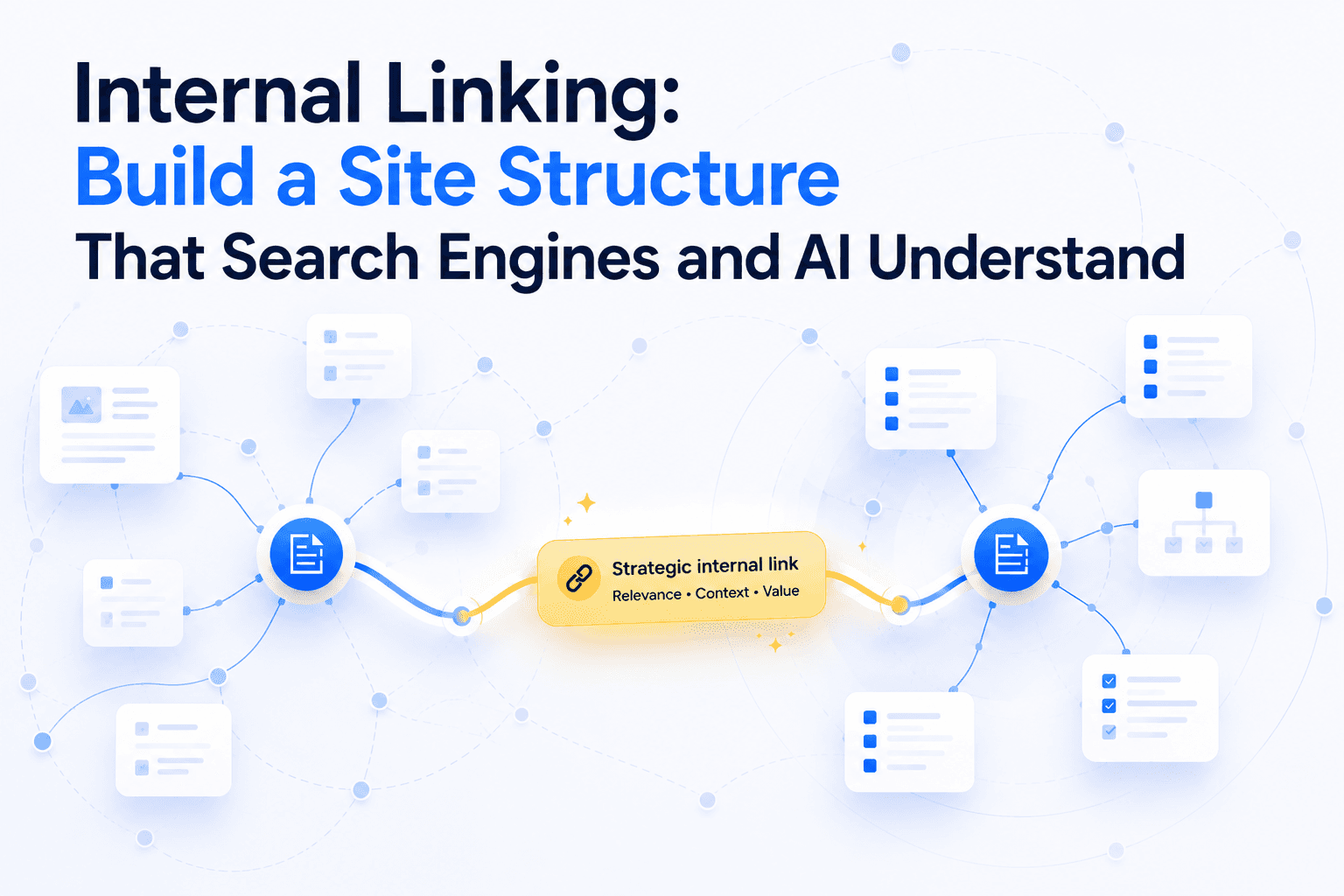
Internal links do four things at once: they tell search engines what exists, where authority should flow, how your content relates to itself, and which topics your site is an authority on. Most websites optimize for the first two and ignore the last two entirely.
When you publish a page and link to it from existing content, you are doing more than creating a navigation path. You are making four simultaneous declarations to every system that crawls your site.
1. Crawl discovery. Search engine bots follow links to find new pages. A page with no internal links pointing to it (an orphan page) may never be crawled at all, even if it appears in your XML sitemap. On large sites, this directly affects how Google allocates its limited crawl budget.
The sitemap tells Google the page exists. The internal link tells Google the page matters.
2. Authority distribution. Every page on your site holds some amount of ranking authority, accumulated from backlinks, user signals, and content quality. Internal links are the mechanism by which that authority flows from one page to another.
Your homepage typically holds the most. Without deliberate internal linking, that authority stays concentrated at the top and never reaches the pages you actually want to rank. Backlinks bring authority in, but internal links decide where it goes.
3. Semantic signaling. The text you use in a link (the anchor text) and the sentence surrounding it tell Google what the target page is about. This is not a minor signal. It is one of the primary ways Google builds its understanding of your content's meaning and relationships.
4. Knowledge Graph construction. This is the function most guides miss entirely. Every time you create a contextual internal link with a descriptive anchor, you are not just passing authority. You are telling Google's Knowledge Graph how two concepts on your site relate to each other.
Think of it this way. If your site has a page about crawl depth and a page about internal linking, and you connect them with a link that says "reducing crawl depth through strategic internal links," you are making a typed declaration: internal linking solves crawl depth problems. Google registers that relationship between the two concepts, not just the flow of authority between the two URLs.
This is why the old "water flowing through pipes" metaphor for internal linking is incomplete.
Pipes carry volume. They do not carry meaning. Your internal links carry both.
The practical implication is simple. Every internal link you create should answer two questions: does this link help the reader, and does the anchor text accurately describe the relationship between these two pages?
If the answer to either is no, the link is wasted or, worse, sending the wrong signal.
Not All Links Are Equal: How Google Decides Which Ones Count
Google assigns different weights to different links on the same page. A single well-placed link in your content body can transmit more ranking value than ten links buried in your footer. This is not a theory. It is a patented system called the Reasonable Surfer.
Most SEO guides treat internal links as if each one carries the same weight. Add more links, pass more authority, improve rankings.
The reality is more nuanced. And understanding the nuance changes how you build links.
The Reasonable Surfer model
In its early years, Google's PageRank algorithm used a "Random Surfer" model. It assumed a visitor would click any link on a page with equal probability. A link in the main content carried the same weight as a link in the footer or a Terms of Service link in the sidebar.
Google moved past that model. Patent US8117209B1, first filed in 2004 and updated in 2016, introduced the Reasonable Surfer model. Instead of treating all links equally, Google estimates the probability that a real user would actually click each link. Links with a higher click probability pass more PageRank.
The patent identifies several factors that influence this probability:
- Position on the page. Links above the fold and early in the content carry more weight than links below the fold or at the bottom of the page.
- Visual prominence. Larger font size, bold text, or contrasting color increase the estimated click probability.
- Number of words in the anchor. Longer, more descriptive anchors signal higher click intent than single-word anchors.
- Relevance of the anchor to the surrounding content. A link that fits naturally into the paragraph's argument is more likely to be clicked than a link that feels disconnected.
- Content vs. navigation. Links in the main body of content carry more weight than navigation links, footer links, or sidebar widgets.
- Internal vs. external. The model distinguishes between links to the same domain and links to other domains.
The 2016 update to the patent added a stronger emphasis on actual user behavior data, not just predicted behavior. Google uses real click patterns (from Chrome and other sources) to refine its model of which links are likely to be followed.
The practical takeaway: one contextual link placed early in a relevant article, with a descriptive 3-to-8-word anchor, transmits more value than a dozen navigation links repeated on every page of your site.
What the Google API leak confirmed
In May 2024, over 14,000 internal Google API documents were inadvertently published on GitHub. Among the ranking signals revealed, several directly relate to how Google processes internal links.
anchorMismatchDemotion. This is a demotion signal applied to links whose anchor text does not match the content of the target page.
This confirms that Google does not simply ignore irrelevant anchors. It actively penalizes them. The recommendation to "use descriptive anchor text" is not just a best practice. It is an imperative backed by a specific penalty mechanism.
Multiple PageRank variants. The documents reveal seven types of PageRank, including pageRank_NS (Nearest Seed), which is associated with document clustering and topical understanding. This means Google does not distribute authority through a single generic flow. It evaluates thematic proximity between linked pages. A link between two semantically related pages transmits more value than a link between two pages with no topical connection.
siteAuthority. The leak confirmed the existence of a site-wide authority metric, contradicting years of public statements from Google. Internal linking is the primary mechanism through which this site-level authority gets distributed to individual pages.
These signals reinforce what the Reasonable Surfer patent implies. Internal links are not equal, and Google's systems are far more sophisticated about evaluating them than most practitioners assume.
✓ Link in the first two paragraphs of body content, descriptive anchor, topically relevant target ✓ Link with 3-8 word anchor that describes the target from the reader's perspective ✓ Link from a high-authority page to a strategically important target
❌ Footer link repeated on every page with the same generic anchor
❌ Link with anchor text unrelated to the target page's content (triggers anchorMismatchDemotion)
❌ Link buried at the bottom of a page nobody scrolls to
Why Your Anchor Text Strategy Probably Works Against You
The variety of your anchor text matters more than the volume of your internal links. Pages that receive links with many different anchor text variations consistently outperform pages that receive more links with the same anchor repeated. The data is strong enough that Zyppy ran it three times.
Most websites fall into one of two anchor text patterns. Either they repeat the same anchor (usually the page title or the target keyword) everywhere, or they use generic text like "read more" or "click here." Both are common internal linking mistakes that waste the most powerful signal internal links can carry.
What the data shows
The Zyppy study of 23 million internal links across 1,800 websites found that anchor text variety was more strongly correlated with Google search traffic than the raw number of internal links. The correlation was so strong that the research team verified the data three times, eliminating close to 50% of outliers. The pattern held every time.
Authority Hacker confirmed the same pattern with a completely different methodology, analyzing 100,000 URLs ranking in the top 20. The higher a page ranked, the more unique anchor text variations it had pointing to it.
Additional findings from the Zyppy study:
- Pages with at least one exact-match anchor received five times more traffic than pages without any. Exact-match anchors are not inherently dangerous for internal links. They are one tool in a larger toolkit.
- Beyond 45-50 internal links, traffic started to decline. More is not always better. Relevance and uniqueness matter more than volume.
- The variety of anchors mattered more than the total count of links. A page with 15 internal links from 15 different anchor variations outperformed a page with 30 links using only 3 variations.
Why diversity beats repetition
Each anchor text acts as a contextual vote about what the target page covers. When ten different pages link to your "crawl depth" guide using ten different anchors, Google receives ten complementary signals about that page:
- "reduce the number of clicks to your deep pages"
- "pages buried in your site architecture"
- "how Googlebot explores site depth"
- "making important content more accessible"
- "fixing pages that are too far from the homepage"
Each anchor describes the same page from a different angle. Google's understanding of what that page covers becomes richer, more nuanced, and more aligned with the variety of queries real users type.
Now compare that to ten links all using the same anchor: "crawl depth guide."
Google receives the same signal ten times. Louder, but not richer.
This also explains why the LinkStorm study of 2.5 million contextual internal links found that only 8% of anchors strongly matched the target page's title.
The study presented this as a problem. It is more accurately an opportunity.
What matters is not that the anchor copies the title, but that it describes the target page from a relevant and complementary angle.
The anchor sweet spot
Data from the LinkStorm study shows that 61% of internal anchors contain only 1 to 3 words, while 14% are very long (11+ words). The middle range of 3 to 8 words is underrepresented, which is notable because this is the range that carries the most semantic signal per word.
A practical framework:
- 1-2 words: Too short for meaningful semantic context. Use sparingly.
- 3-8 words: The sweet spot. Long enough to describe the target, short enough to stay focused. Examples: "reducing crawl depth on large sites," "contextual anchor text best practices."
- 9+ words: Starts to read like a sentence fragment rather than a link. Can work if the phrasing is natural, but risks diluting focus.
- Generic ("click here," "read more"): About 15% of all internal anchors are still generic. Each one is a wasted opportunity to send a semantic signal.
One exact-match anchor per target page gives Google a strong primary signal. Every additional link should vary the phrasing to cover related angles, long-tail variations, and complementary descriptions.
Internal Linking for AI Visibility: What the First Data Shows
Search engines are no longer the only systems reading your internal links. LLMs like ChatGPT, Perplexity, and Google's AI Overviews use your link structure to decide whether to cite your content. The early data suggests that good internal linking significantly increases your chances of being cited.
The rise of AI-generated search answers creates a new reason to care about internal linking. When an LLM generates a response, it needs to decide which sources to cite. Internal links help these models understand which pages on your site are authoritative on a given topic, and how your content connects.
This is different from how traditional search engines use links. Google uses PageRank and the Reasonable Surfer to estimate authority and relevance. LLMs use link structure to build a semantic map of your site, inferring relationships between concepts based on anchor text, surrounding context, and the pattern of connections. The way contextual links influence AI search visibility is fundamentally semantic, not structural.
What the early data shows
The research is young, but the signals are consistent:
- Bidirectional internal links increase AI citation probability by 2.7x. A Wellows and Yext study (2025) found that pages linked reciprocally (A links to B and B links back to A) were significantly more likely to be cited in AI-generated responses.
- Pages cited by AI systems average 35-45 internal links, compared to a median of 20-25 for uncited pages. This comes from Cognism's audit of over 800 URLs.
- 44.2% of LLM citations come from the first 30% of a page's content. Kevin Indig's analysis of 1.2 million verified ChatGPT citations (February 2026) confirms that LLMs scan for the answer before deciding whether to cite the source. Links placed early in the content, near key claims and definitions, are more likely to be followed and processed.
- Adding 3-5 contextual internal links led to a 100-150% boost in traffic from AI search tools, according to a study cited by LinkBuilder.io.
These numbers should be treated as early indicators, not settled science. The methodologies vary, sample sizes are modest, and the field is evolving fast.
But the direction is consistent: well-structured internal linking improves AI visibility.
What this means in practice
A few principles emerge from the early data:
Descriptive anchors matter even more for LLMs. A language model does not just read the anchor text. It reads the entire sentence around the link. The combination of anchor + surrounding context is how the model understands the relationship between two pages. Vague anchors surrounded by generic text give the model nothing to work with.
Structure your pages so each section is self-contained. LLMs extract specific passages, not entire pages. If a section begins with a clear statement, contains a cited data point, and includes a relevant internal link, it becomes a citable unit. Sections that meander before reaching their point are less likely to be selected.
Bidirectional linking strengthens the signal. If page A links to page B but page B never links back, the relationship is one-directional. LLMs (and Google) interpret mutual linking as a stronger indicator that the two pages genuinely belong to the same topic cluster. This is why building semantic clusters with intentional cross-linking matters more than ever.
The good news: optimizing internal links for AI visibility and optimizing for traditional SEO are largely the same work. Descriptive anchors, relevant connections, shallow crawl depth, and clear topic structure benefit both systems.
You do not need two separate strategies.
The Internal Linking Audit: How to Find and Fix What Matters First
You cannot fix every internal link at once, and you do not need to. Start with the five diagnostics that reveal the highest-impact problems, then follow a prioritization framework that focuses effort where it actually moves rankings.
Internal linking audits fail when they produce a list of 500 "opportunities" with no way to prioritize.
The goal is not to add more links everywhere. It is to identify the specific connections that are missing or broken, and fix the ones that will have the most impact first.
Five diagnostics to run first
1. Orphan pages. Pages with zero internal links pointing to them. These are invisible to crawlers and receive no authority. Crawl your site with a tool like Screaming Frog, then cross-reference against Google Search Console data. Pages that get impressions in Search Console but do not appear in your crawl are your orphans.
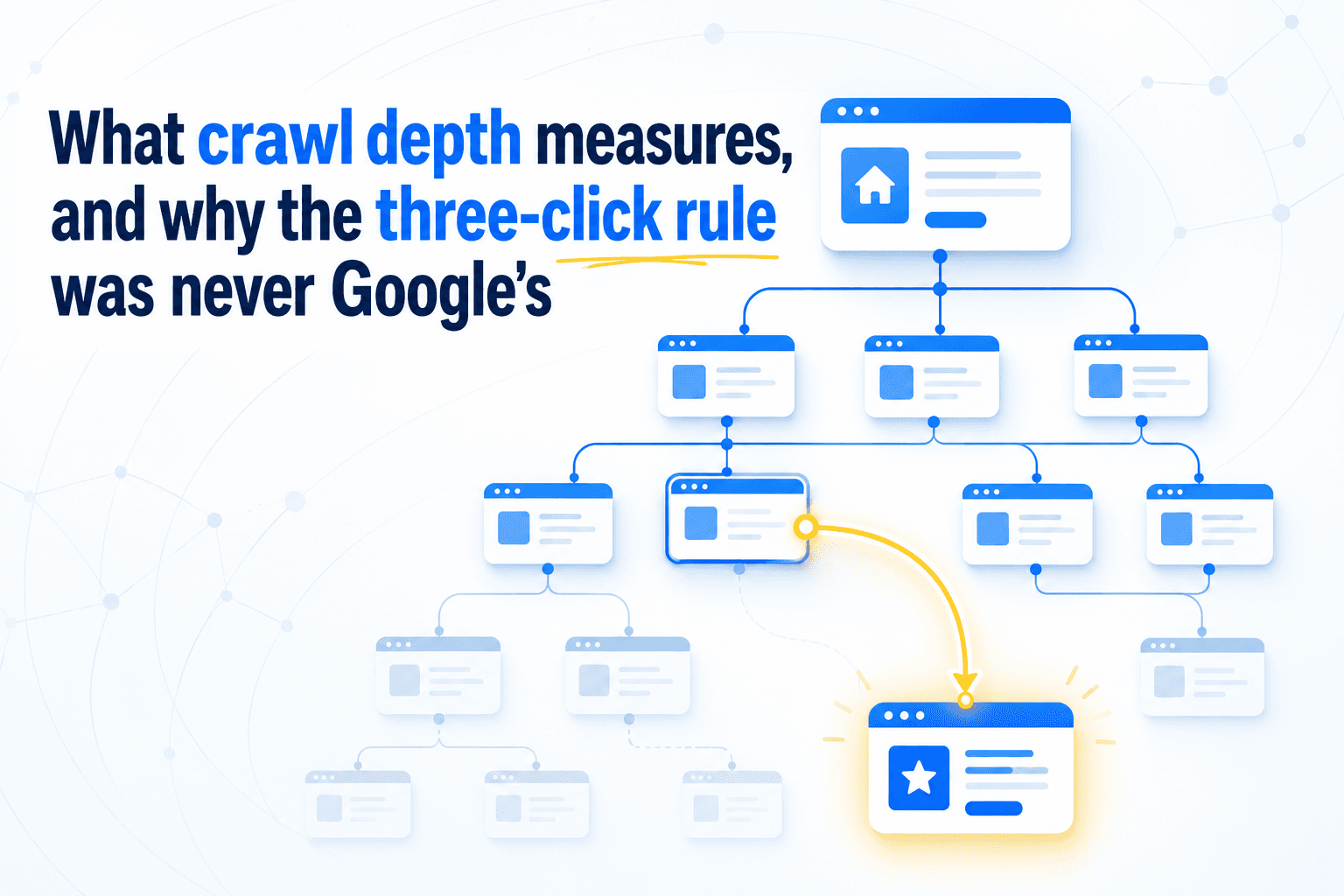
2. Crawl depth > 3. Pages that require more than three clicks to reach from the homepage are deprioritized by Google's crawler. The LinkStorm study confirmed that 71% of contextual internal links fall within the first two levels of site hierarchy. Pages buried at depth 4 or beyond need direct links from higher-level pages.
3. High-potential pages that are under-linked. Look for pages ranking on page 2 of Google for valuable keywords. These pages have enough content quality to nearly rank but may lack the internal link support to break through.
A few contextual links from high-authority pages can be the catalyst.
4. Generic or mismatched anchor text. Search your internal links for "click here," "read more," "learn more," and other generic anchors. Each one is a missed semantic signal. Also check for anchors that do not match the target page's content (remember: Google's anchorMismatchDemotion actively penalizes this).
5. Redirect chains. Internal links that pass through one or more redirects before reaching the final page waste crawl budget and dilute link equity. Update these to point directly to the final destination URL.
The prioritization framework
Not all fixes are equally urgent. Use this matrix:
| Priority | Criteria | Examples |
|---|---|---|
| Fix first | High impact, high relevance, easy to add | Broken links, orphan pages with business value, page-2 keywords needing a link boost |
| Fix second | High impact, high relevance, harder to add | Restructuring a major topic cluster, rewriting generic anchors across many pages |
| Fix third | Lower impact, cluster support | Adding sibling links between related blog posts, breadcrumb improvements |
| Defer | Low relevance or low business impact | Linking between unrelated content sections, cosmetic navigation changes |
The 90-day workflow
Days 1-14: Diagnose. Run a full crawl. Identify orphans, depth problems, broken links, and redirect chains. Map your highest-value pages and check their internal link count. Do not fix anything yet. Understand the landscape first.
Days 15-45: Fix the critical issues. Eliminate broken links and redirect chains. Connect orphan pages. Add 3-5 contextual internal links to your page-2 keywords from your strongest existing pages. Replace generic anchors with descriptive ones.
Days 46-90: Strengthen clusters. Pick your 1-3 most important topic areas. Ensure the pillar page links to every supporting page, every supporting page links back to the pillar, and sibling pages link to each other where relevant. Use varied anchor text for every connection. For e-commerce sites, this means bridging product pages, category pages, and content rather than letting template-generated widgets do all the work.
When you structure these clusters, the direction of links matters. Supporting pages should point upward to the pillar. Sibling pages should link horizontally to each other. The pillar links down to each supporting page.
This principle, formalized in the French SEO tradition as the "cocon sémantique" (semantic cocoon) by Laurent Bourrelly, adds a layer of precision that flat, bidirectional topic clusters lack: it controls not just which pages are connected, but how authority and semantic relevance flow through the structure.
The pillar accumulates relevance from below. The supporting pages inherit authority from above.
After day 90: Integrate into publishing. Every new page published should include 3-5 internal links to relevant existing content. And 3-5 existing pages should be updated to link back to the new page. This prevents your architecture from fragmenting as your site grows.
For sites with fewer than 200 pages, this process is manageable manually.
Beyond that, the challenge becomes identification: finding the right pairs of pages to connect and the right anchors to use across thousands of possible combinations. This is where AI-powered internal linking tools and semantic matching through embeddings (analyzing the actual meaning of each page, not just keyword overlap) become essential to surface connections that keyword-based tools miss.